How Florida Humidity Destroys the Wrong Flooring — and What Actually Survives in Tampa Bay
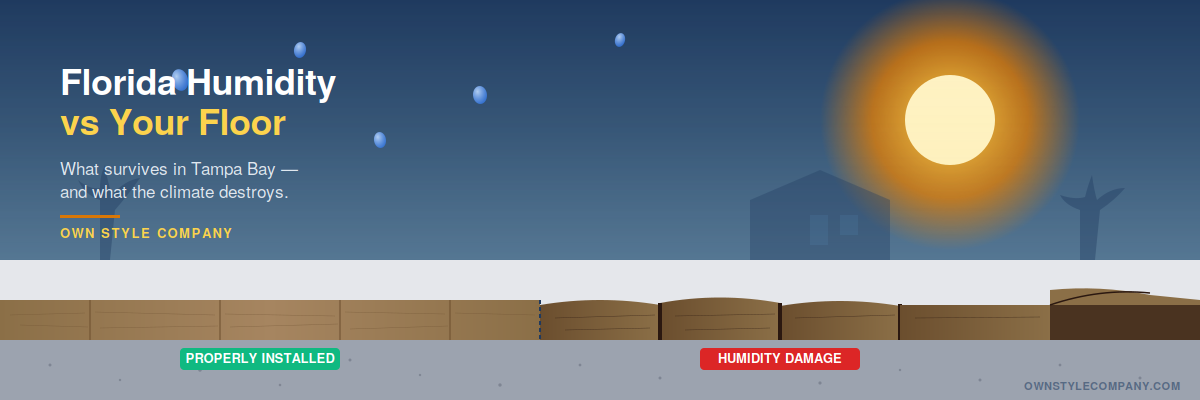
Florida humidity and A/C cycling destroy flooring faster than almost any other climate in the United States. In Tampa Bay, the combination of year-round humidity (averaging 75%), A/C running 9+ months, and concrete slab foundations creates conditions that most flooring products — including most laminate and engineered wood — were never designed to handle. The floors that actually survive here are waterproof luxury vinyl plank (LVP), properly sealed ceramic or porcelain tile, and a small category of laminate rated AC4 or higher installed with a proper moisture barrier. Everything else cups, gaps, or delaminates within 2–5 years.
We install and replace floors across Tampa, Brandon, Riverview, Seffner, and the rest of Hillsborough County every week. The patterns are consistent enough that, from the first 5 minutes inside a home, we can usually tell what went wrong.
Why does Florida humidity damage flooring so badly?
Wood and wood-based flooring (including laminate, which has a wood-fiber core) is hygroscopic — it absorbs and releases moisture from the air. In a dry climate, this cycle is small and predictable. In Florida, the air can hold 75% relative humidity in the morning, drop to 50% when the A/C has been running for 4 hours, and climb back to 70% overnight. That constant swing expands and contracts the flooring every single day for years.
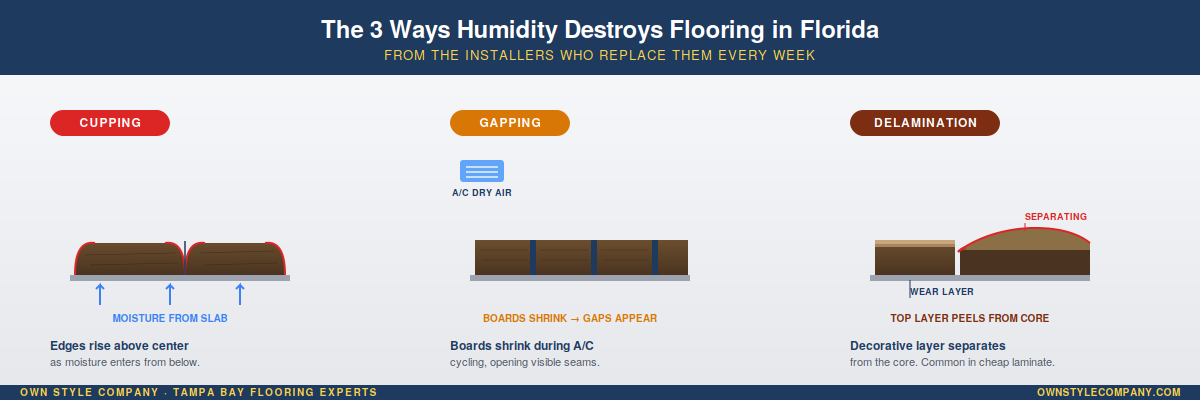
Three failure modes follow:
• Cupping — the edges of boards rise above the center as moisture enters from below.
• Gapping — boards shrink during prolonged A/C running, opening visible seams.
• Delamination — the decorative wear layer separates from the core. Most common in cheap laminate under $1.50/sqft.
What flooring actually survives in Tampa Bay?
After thousands of square feet installed across Tampa Bay, the short list of flooring that reliably handles our climate is shorter than most homeowners expect.
Luxury Vinyl Plank (LVP) — the workhorse
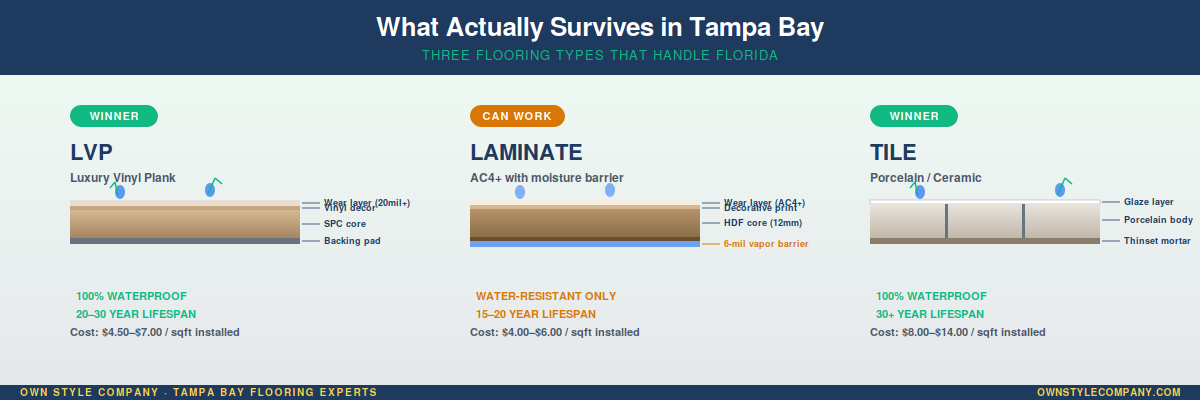
LVP is 100% waterproof, dimensionally stable through humidity swings, and tolerant of the A/C cycling that ruins laminate. SPC-core LVP in particular (Stone Plastic Composite) barely moves at all. For most Tampa Bay homes, this is the default recommendation. Typical installed cost: $4.50–$7.00/sqft depending on thickness and brand.
AC4+ laminate with a proper moisture barrier
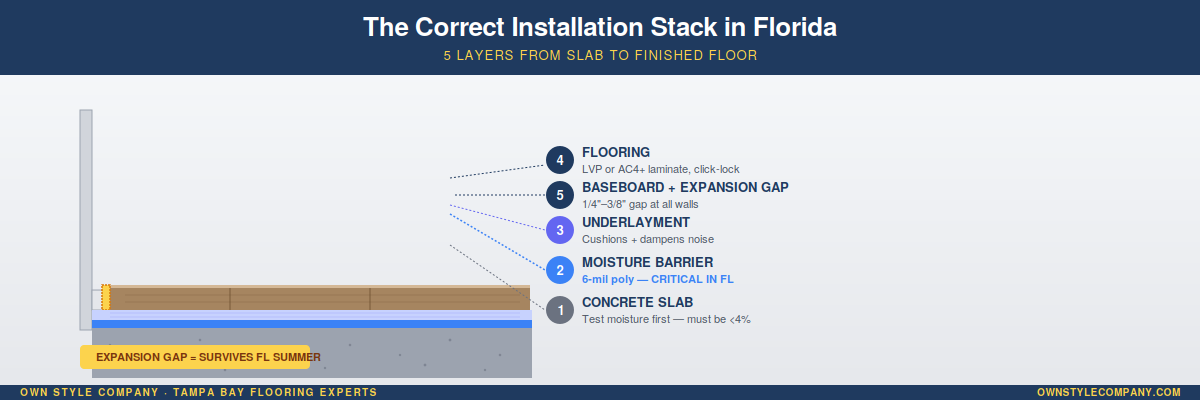
Not all laminate fails in Florida. Laminate rated AC4 or AC5 with a 12mm core, installed over a 6-mil polyethylene moisture barrier on a slab that tested below 4% moisture content, can last 15+ years here. The problem is that 80% of laminate installed in Tampa Bay is AC3 or lower, installed without moisture testing. That is the laminate we keep tearing out.
Porcelain or ceramic tile
The original Florida flooring for a reason. Completely unaffected by humidity, easy to clean after a flood, and ideal for coastal homes with salt air. The trade-offs are cost ($8–$14/sqft installed), hardness underfoot, and the demolition cost if you ever want to change it later.
What flooring should Tampa Bay homeowners avoid?
Three categories we actively recommend against unless the home has exceptional climate control:
• Solid hardwood on slabs. Most Tampa Bay homes are built on concrete slabs. Solid hardwood is not designed for direct slab installation and will cup, crown, or buckle within 2–3 humid seasons.
• Bamboo. Marketed as durable, but strand-woven bamboo swells dramatically under Florida humidity. We have replaced it in multiple homes in Riverview and Brandon within 4 years of original install.
• Budget laminate (under $1.50/sqft). Thin wear layer, weak core, no realistic moisture protection. Cupping within 2 years is almost guaranteed.
The installation details that matter more than the product
A premium LVP installed badly will fail faster than a budget laminate installed correctly. In Tampa Bay installs, these are the details that decide whether the floor survives 5 years or 20:
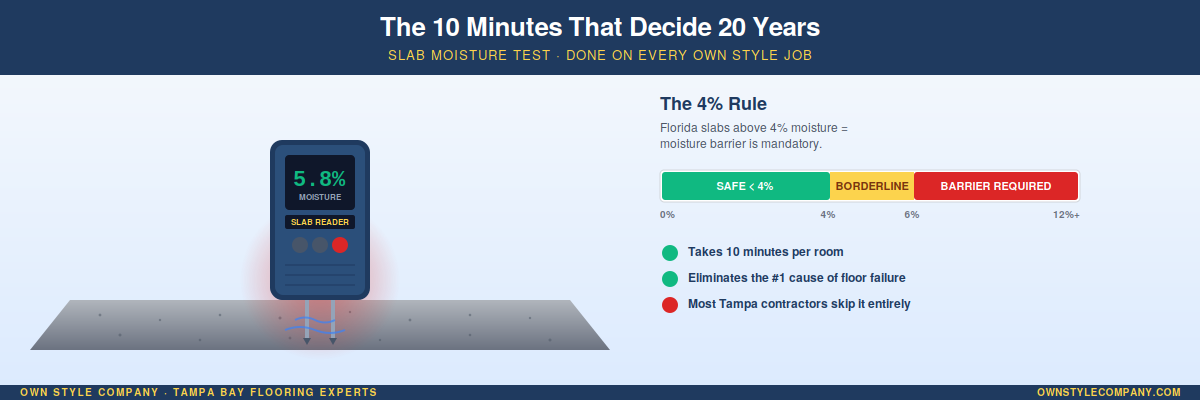
• Slab moisture test before install. Anything above 4% moisture content means a moisture barrier is mandatory.
• Acclimation. The flooring sits in the home, in its final room, for 48–72 hours before installation so it matches the home's humidity baseline.
• Expansion gap. Every plank floor needs a 1/4" to 3/8" gap along walls and fixed objects. In Florida, skip this and the floor will buckle the first summer.
• Underlayment. Correct thickness, correct vapor properties, installed without seams overlapping the plank seams.
In our installations across Tampa Bay, Yasmany checks the moisture reading on every slab before we place the first underlayment roll. It takes 10 minutes and eliminates the single most common cause of premature floor failure.
Frequently Asked Questions
-
Properly installed LVP or tile: 20–30 years. Properly installed AC4+ laminate with moisture barrier: 15–20 years. Improperly installed budget laminate: 2–5 years before visible damage.
-
Yes. Keeping indoor relative humidity between 45% and 55% is ideal. Setting the A/C aggressively (below 70°F) while outdoor humidity is high creates condensation on slab surfaces and accelerates moisture damage from below, especially in homes built before 1995 without modern vapor barriers under the slab.
-
Often yes — this is one of our most common Tampa Bay jobs. If the tile is level, intact, and structurally sound, a floating click-lock laminate or LVP installation over it eliminates demo cost and shortens the project. We recently installed 1,900 sq ft of LVP directly over tile in a Tampa home, with carpet removal in two bedrooms, completed in a single day.
-
LVP: $4.50–$7.00/sqft including materials and installation. Laminate (AC4+): $4.00–$6.00/sqft. Porcelain tile: $8.00–$14.00/sqft. Demolition of existing flooring adds $1.50–$3.00/sqft depending on material. Subfloor leveling, when needed, adds $1.50–$4.00/sqft.
-
Sometimes. Thick engineered hardwood (5mm+ wear layer) in climate-controlled homes with good subfloor preparation can work. In coastal or uncontrolled environments, it still moves more than LVP or tile. We cover this in depth in our engineered vs solid hardwood article.
What to do next
If you are planning a flooring project in Tampa Bay, start with two questions: (1) is your subfloor a concrete slab, and (2) what is the current moisture reading? Those two facts eliminate more than half the flooring options most manufacturers will try to sell you. A professional installer should test moisture before quoting, recommend a moisture barrier where needed, and size the expansion gap to Florida conditions — not to the minimum on the manufacturer's instruction sheet.
Flooring at Tampa Bay installs flooring across Tampa Bay, including Seffner, Brandon, Riverview, and Tampa proper. We test every slab before installation and build the moisture strategy into the quote, not as an upsell. For a quote or consultation, call (813) 455-5756 or visit ownstylecompany.com.