Hurricane Season and Your Floors: What Tampa Bay Homeowners Need to Know Before June
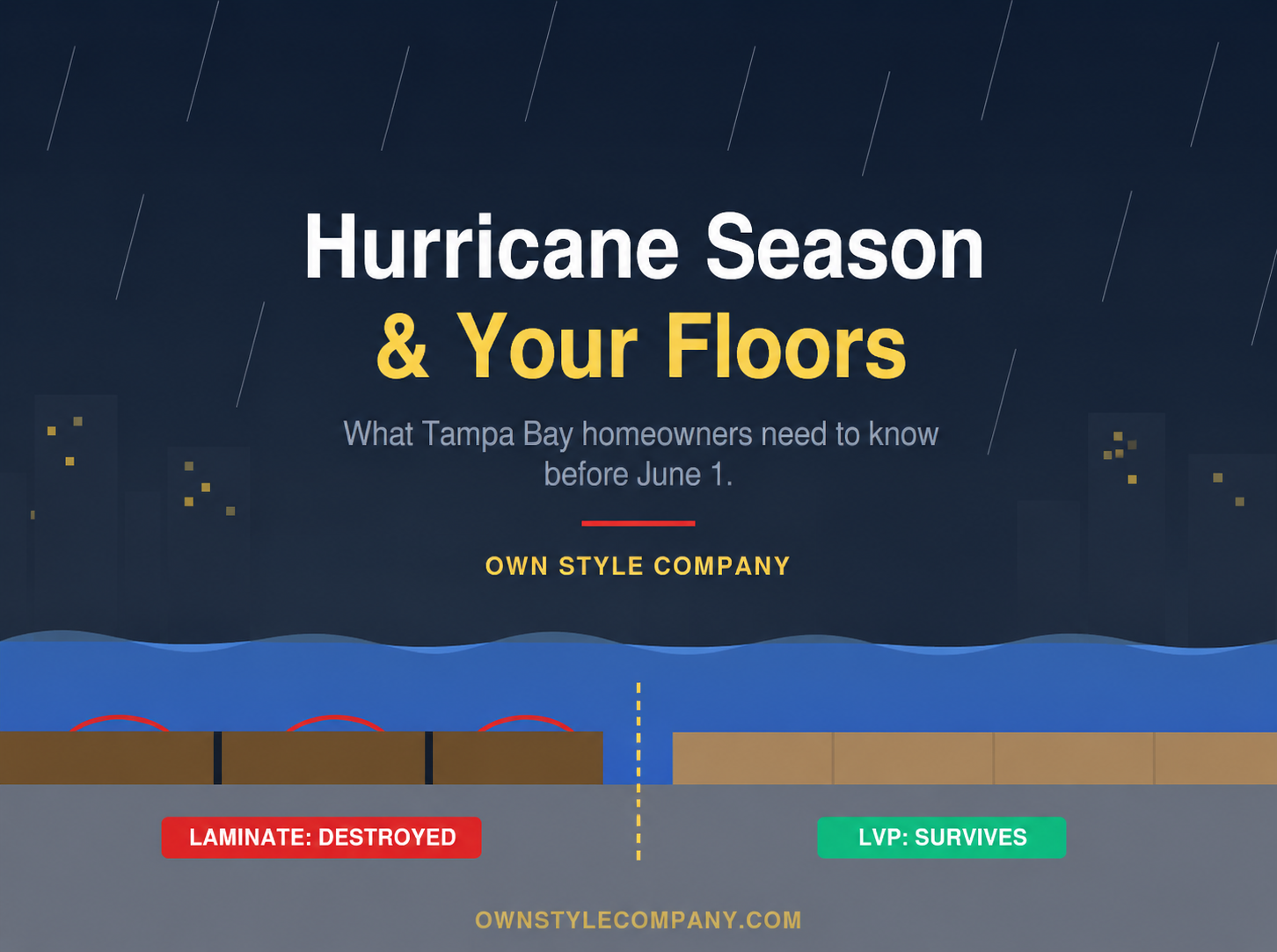
If your Tampa Bay home takes even 2 inches of water during a hurricane or tropical storm, your flooring is the first casualty. Laminate and carpet are destroyed. Tile and LVP survive. The difference between a $2,000 cleanup and a $15,000 full-floor replacement often comes down to which material was on the ground when the water came in. Hurricane season runs June 1 through November 30, and the time to evaluate your flooring is before the first named storm, not after.
We install and replace flooring across Tampa, Brandon, Riverview, and Seffner year-round, but every September and October we see the same pattern: homeowners calling after a storm, standing in a house that smells like mildew, looking at a laminate floor that is already cupping and separating. This article is what we wish every Tampa Bay homeowner knew before that call.
What happens to each flooring type during a flood?
Not all flooring fails the same way under water. The timeline and the damage pattern depend entirely on the material. Here is what we see after storms in Tampa Bay:
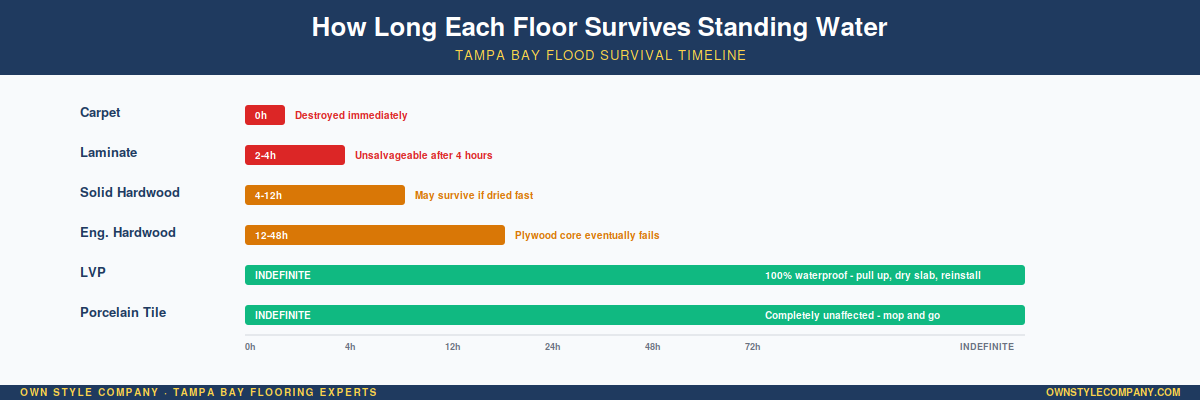
• Laminate: The HDF core absorbs water within hours. Boards swell, edges cup, seams separate. Within 24 hours of standing water, most laminate is unsalvageable. The damage is not reversible — even if the floor dries, the core is permanently expanded and weakened. Mold begins in the underlayment within 48 hours.
• Carpet: Absorbs water immediately. The carpet pad underneath is a sponge that holds moisture against the slab for days. Mold colonizes carpet pad within 24–48 hours in Florida heat. Carpet that has been flooded must be removed — cleaning alone does not eliminate the mold risk in our climate.
• LVP (Luxury Vinyl Plank): Waterproof. Survives standing water for days. After the water recedes, dry the subfloor, clean the surface, and the floor is fine. No swelling, no delamination, no mold in the material itself. The only risk is water trapped under the LVP against the slab — which is why pull-up-and-dry is the correct protocol, not wait-and-hope.
• Porcelain/Ceramic Tile: Completely unaffected by water. Mop it up, check the grout, done. The original Florida floor for exactly this reason.
• Solid Hardwood: Absorbs water faster than laminate. Boards cup, crown, and buckle. Can sometimes be sanded and refinished after professional drying, but in many cases the subfloor is also damaged. Expensive either way.
• Engineered Hardwood: Better than solid but not waterproof. Plywood core resists water longer than HDF but eventually delaminates. Not a safe bet in flood-prone zones.
The first 72 hours after water enters your home
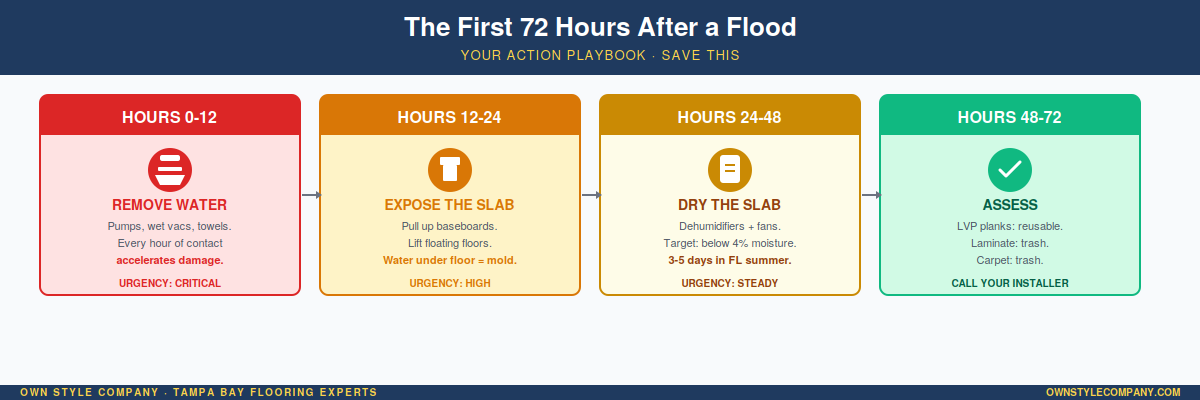
What you do in the first 72 hours decides whether you are replacing 200 square feet or 2,000. Tampa Bay contractors, insurance adjusters, and water mitigation companies all agree on the same sequence:
• Hours 0–12: Remove standing water. Pumps, wet vacs, towels — whatever gets water off the floor fastest. Every hour of contact accelerates damage exponentially.
• Hours 12–24: Remove baseboards. Pull up any floating floor (laminate, LVP, engineered) to expose the slab. This is critical — water trapped between the floor and the slab is where mold starts. Even waterproof LVP needs to be lifted so the slab can dry.
• Hours 24–48: Run dehumidifiers and fans on the exposed slab. Target is getting slab moisture below 4% before any flooring goes back down. In Florida summer humidity, this can take 3–5 days with commercial dehumidifiers.
Hours 48–72: Assess what is salvageable. LVP planks: almost always reusable. Laminate: almost never. Carpet and pad: never. Tile: always fine, just clean grout lines
Which rooms are most vulnerable in Tampa Bay homes?
Flooding does not hit every room equally. In Tampa Bay, the pattern we see most often:
• Ground-floor rooms facing the street or the yard drainage slope — these flood first and deepest.
• Garages and laundry rooms attached to the main floor — water enters through the garage door seal or the laundry drain.
• Kitchens and bathrooms — not from the storm, but from pipe bursts caused by storm-related pressure changes.
• Sliding glass door rooms (Florida rooms, lanais) — the track seal fails under wind-driven rain.
Second-floor rooms rarely flood from storms. If you are choosing flooring for a second floor, the hurricane calculus does not apply — humidity and A/C cycling are the bigger concerns there (see our guide on Florida humidity and flooring).
Can you hurricane-proof your floors?
You cannot make a home flood-proof. But you can make the floor decision that minimizes the cost when water comes in. The strategy is simple:
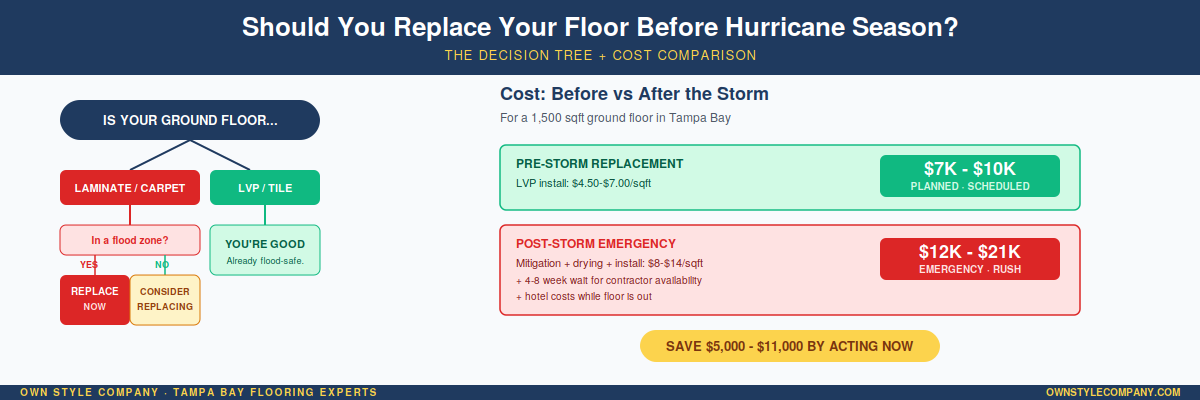
• Ground-floor rooms in flood-vulnerable areas: LVP or tile. Full stop.
• Ground-floor rooms in low-risk areas (interior rooms, elevated slabs): laminate is acceptable if installed with a proper moisture barrier and the home has flood insurance.
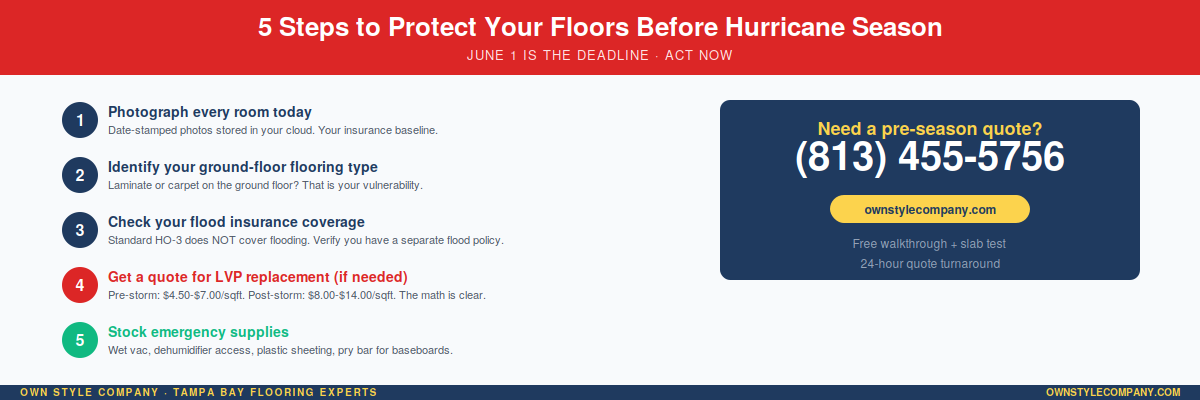
• If you already have laminate on the ground floor and the home is in a flood zone: consider replacing before hurricane season, not after. Pre-storm replacement costs $4–$7/sqft. Post-storm emergency replacement costs $8–$14/sqft with mitigation, drying, and rush scheduling.
What about flood insurance and flooring claims?
This is not legal advice — talk to your insurance agent. But from what we see in Tampa Bay after storms:
• Standard homeowner’s insurance (HO-3) does not cover flooding. You need a separate flood policy (NFIP or private).
• Flood policies typically cover flooring replacement at actual cash value (depreciated), not replacement cost, unless you have an upgraded policy.
• Documentation matters enormously. Before hurricane season, photograph every room’s flooring with a date stamp. This is your baseline for any claim.
• Mitigation effort (removing water quickly, lifting floors, running dehumidifiers) is often required by the policy. Doing nothing and waiting for the adjuster can reduce or void your claim.
Protection checklist — 5 steps to hurricane-proof your floors.
Frequently Asked Questions
-
After water mitigation is complete (3–7 days for slab drying), installation takes 1–3 days for a typical Tampa Bay home. The bottleneck is not the install — it is the drying and the availability of materials and crews. After a major storm, wait times for flooring contractors can stretch to 4–8 weeks. Pre-season replacement eliminates this entirely.
-
Almost never. If laminate has had standing water for more than 2–4 hours, the HDF core is permanently swollen. Even if it looks okay after drying, the internal structure is compromised and the floor will fail within months. The only exception is a very small spill caught immediately and dried within an hour.
-
If the carpet is on a ground floor in a flood-vulnerable area, yes. Carpet and carpet pad are impossible to fully decontaminate after flooding in Florida heat. The mold risk alone makes replacement with LVP a sound investment. Typical cost to remove carpet and install LVP: $5–$8/sqft including demolition.
-
The LVP planks themselves are unaffected by salt water. The concern is salt residue on the slab after the water recedes. A thorough cleaning before reinstallation prevents any long-term issues. Salt water is far more damaging to laminate, hardwood, and carpet than to LVP or tile.
-
Pre-storm LVP installation: $4.50–$7.00/sqft in Tampa Bay. Post-storm replacement including water mitigation, slab drying, emergency scheduling, and inflated material demand: $8.00–$14.00/sqft. For a 1,500 sqft ground floor, that is the difference between $7,500–$10,500 and $12,000–$21,000.
-
Walk your ground floor. Look at what is under your feet. If it is laminate or carpet and the home has flooded before — or sits in a flood zone — the math is clear. Replacing before the storm is cheaper, faster, and eliminates the worst-case scenario entirely.
Flooring at Tampa Bay installs LVP and tile across Tampa Bay, including Seffner, Brandon, Riverview, and Tampa proper. We can walk your home, test the slab, and give you a quote in 24 hours. For hurricane-season consultations, call (813) 455-5756 or visit ownstylecompany.com.