Why Your AC Is Damaging Your Floor — and How to Stop It
Your air conditioner does not just cool the air — it dehumidifies it. And in Tampa Bay, where AC runs nine months out of the year, that dehumidification is one of the leading causes of floor damage we see across Hillsborough County. When your AC pulls moisture from the air, wood-based flooring — laminate, engineered hardwood, and solid hardwood — contracts. When the system shuts off or outdoor humidity seeps back in, the floor expands. This daily cycle of expansion and contraction causes gaps between planks, cupping, squeaking, and eventually structural failure. The solution is not to run your AC less. It is to control the humidity range.
In our installations and assessments across Tampa Bay, Yasmany and the field team find AC-related floor damage in roughly one in three homes we visit for repair consultations. The damage rarely looks the way homeowners expect.
What Does AC Do to Your Floors, Exactly?
Air conditioners work by circulating air over cold coils, which causes moisture to condense and drain away. This process lowers indoor relative humidity — often significantly. In a Tampa Bay home running AC continuously during summer, indoor RH can drop to 35–40% or lower, well below the 45–55% range that most flooring manufacturers require to maintain their warranties.
Wood-based flooring responds directly to the moisture content in the surrounding air. When the air dries out, the floor loses moisture and shrinks slightly. When humidity rises — when the AC cycles off overnight, or on a rainy day when doors are opened — the floor absorbs moisture and expands. Most flooring is engineered to handle a limited range of this movement. Florida's extremes push past that range.
The result is what installers call 'seasonal movement' — except in Tampa Bay, it is not seasonal. It is daily.
Which Flooring Types Are Most at Risk?
Not all flooring responds the same way to AC cycling. Here is the vulnerability ranking for Tampa Bay homes:
• Solid hardwood — most vulnerable. Solid wood moves the most with humidity changes. Gaps of 1/8 inch or more between boards are common in dry conditions.
• Laminate — highly vulnerable. The HDF core in laminate swells and contracts significantly. Once the core is compromised, the floor cannot be restored — it must be replaced.
• Engineered hardwood — moderately vulnerable. The cross-ply construction reduces movement, but it is not immune. High humidity cycles still cause cupping over time.
• LVP / SPC vinyl — most resistant. Stone Plastic Composite vinyl contains no wood fiber and maintains dimensional stability across a wide temperature and humidity range.
What Are the Warning Signs That AC Is Damaging My Floor?
• Gaps between planks — especially near exterior walls or under windows, where temperature differences are more extreme.
• Cupping — the edges of boards rise higher than the center, creating a concave surface. A classic sign of moisture imbalance.
• Squeaking — as boards shift microscopically with each step, friction develops at joints and subfloor contact points.
• End-joint separation — gaps form at the short ends of planks, not just the long sides.
• Hollow spots underfoot — the floor separates slightly from the subfloor due to repeated expansion and contraction cycles.
What's the Right Indoor Humidity Level for Floors in Tampa Bay?
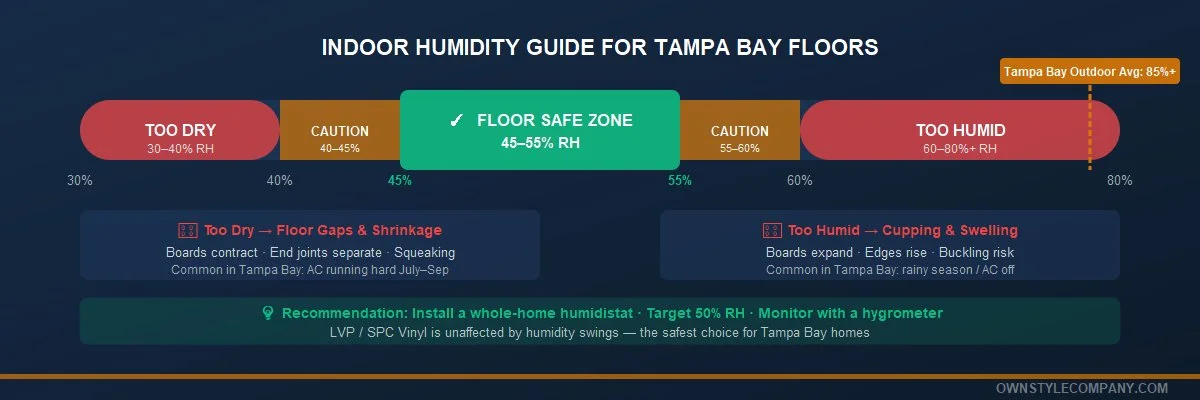
Most flooring manufacturers specify a range of 35–65% relative humidity, but the ideal operational range for wood-based floors in Tampa Bay is 45–55% RH. Below 40% RH, floors dry out and shrink. Above 60% RH, floors absorb moisture, swell, and cup. Florida's outdoor humidity routinely exceeds 85% in summer months — which is why passive ventilation alone cannot protect your floor.
How Can You Protect Your Floors from AC Damage?
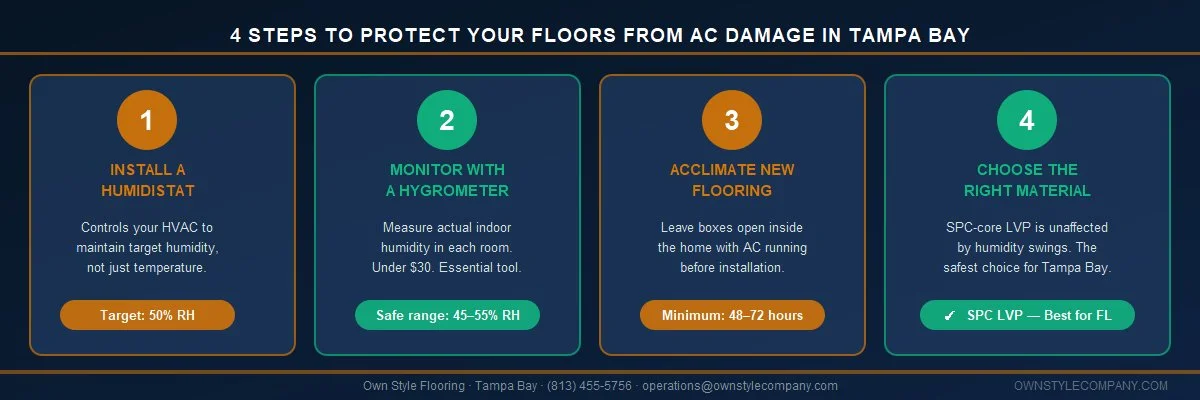
1. Install a whole-home humidistat
A humidistat controls your AC and HVAC system to maintain a target humidity range, not just a target temperature. Set the target to 50% RH and let the system manage it. This is the single most effective intervention for floor protection in Tampa Bay homes.
2. Monitor humidity before and after installation
Before any flooring is installed, indoor RH should be stable within 45–55%. In our pre-installation process, Yasmany takes RH readings in every room. Floors installed in unstable humidity conditions begin failing within months.
3. Acclimate new flooring
All wood-based flooring — including laminate — must acclimate inside the home for a minimum of 48–72 hours before installation. The boxes should be open, and the AC should be running normally.
4. Choose the right material for your conditions
If your home's humidity fluctuates widely and you don't want to invest in humidity control, choose LVP with an SPC core. It is waterproof, dimensionally stable, and unaffected by the humidity swings that damage laminate and hardwood.
Is My Floor Already Damaged — or Can It Be Saved?
• Laminate with swollen or buckled boards — replacement is the only option. Laminate cannot be sanded or refinished, and a compromised core does not recover when dried.
• Engineered hardwood with minor cupping — if caught early and humidity is stabilized, the cupping may self-correct. Severe cupping requires board replacement or sanding and refinishing.
• Solid hardwood with gaps — proper humidity management may close most gaps in the next humidity cycle. Structural damage requires professional assessment.
• LVP that has separated — check the subfloor. LVP itself rarely fails from humidity, but the subfloor beneath it may have moved.
What Flooring Handles AC Cycling Best in Tampa Bay?
• SPC-core LVP — top choice. Rigid, waterproof, stable from 32°F to 140°F, no acclimation required.
• WPC-core LVP — good choice for living areas and bedrooms with stable climate control.
• Engineered hardwood — works well if humidity is actively managed.
• Laminate — use with caution in Florida. Best suited for low-moisture interior rooms with stable humidity.
• Solid hardwood — not recommended for most Tampa Bay homes. Requires strict humidity control year-round.
Flooring at Tampa Bay serves the Tampa Bay area including Brandon, Riverview, Seffner, South Tampa, and surrounding Hillsborough County communities. Contact us at operations@ownstylecompany.com or (813) 455-5756, or visit ownstylecompany.com for a free estimate.
FREQUENTLY ASKED QUESTIONS
-
Yes. AC units dehumidify the air as they cool, causing wood-based flooring — laminate, engineered hardwood, and solid hardwood — to contract. When the system cycles off and humidity rises, the floor expands. This daily cycle creates gaps, cupping, squeaking, and structural damage over time. LVP (Luxury Vinyl Plank) is the most resistant option in Tampa Bay's AC-heavy environment.
-
The ideal indoor relative humidity is 45–55% RH. Below 40%, wood-based floors shrink and gap. Above 60%, they swell and cup. Florida's outdoor humidity regularly exceeds 80%, making a whole-home humidistat or dehumidifier critical for floor protection.
-
Visible gaps between planks (especially near exterior walls), cupping or bowing in the center of boards, squeaking when walking, separation at end joints, and boards that feel hollow underfoot. These symptoms typically appear 6 to 18 months after installation when humidity is not controlled.
-
LVP (Luxury Vinyl Plank), especially SPC-core products. It is 100% waterproof, dimensionally stable across a wide temperature and humidity range, and contains no wood fiber that swells and shrinks. Solid hardwood is the most vulnerable, followed by engineered hardwood and laminate.
-
Install a whole-home humidistat and target 50% RH. Use a hygrometer to monitor actual levels. Allow new flooring to acclimate 48–72 hours before installation. Keep furniture legs padded to reduce floor stress from movement.
-
Yes. Own Style Flooring serves the Tampa Bay area — including Brandon, Riverview, Seffner, and South Tampa — and provides floor assessments that include moisture readings and humidity analysis. Contact operations@ownstylecompany.com or call (813) 455-5756.