Click-Lock vs Glue-Down Installation in Tampa Bay: Pros, Cons, and What We Recommend
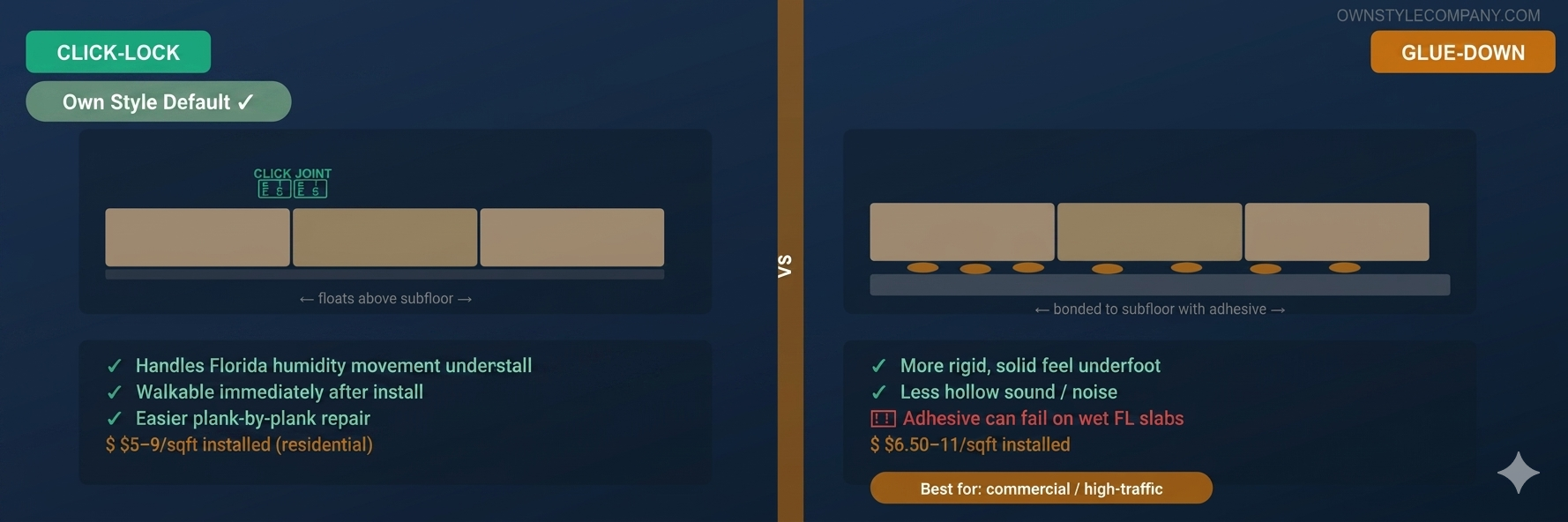
Click-lock (floating) installation and glue-down installation are the two primary methods for installing LVP and laminate flooring in Tampa Bay homes. From the outside, the finished floors look identical. Under the surface, the installation method determines how the floor responds to Florida's humidity, how repairs are handled, and what it costs to put down.
What Is Click-Lock (Floating) Installation?
In click-lock installation, each plank connects to adjacent planks through a precision-machined tongue-and-groove locking system. The planks lock together to form a continuous surface. The floor as a whole floats over the subfloor — it is not glued, nailed, or stapled to the substrate.
• Movement accommodation: the floor expands and contracts as a unit in response to temperature and humidity changes without stressing individual planks or joints.
• No adhesive: eliminates the risk of adhesive failure due to moisture, temperature, or incompatible products.
• Faster installation: no adhesive cure time. The floor is walkable immediately after installation.
• Easier repairs: a damaged plank can be replaced by disassembling the floor back to that point.
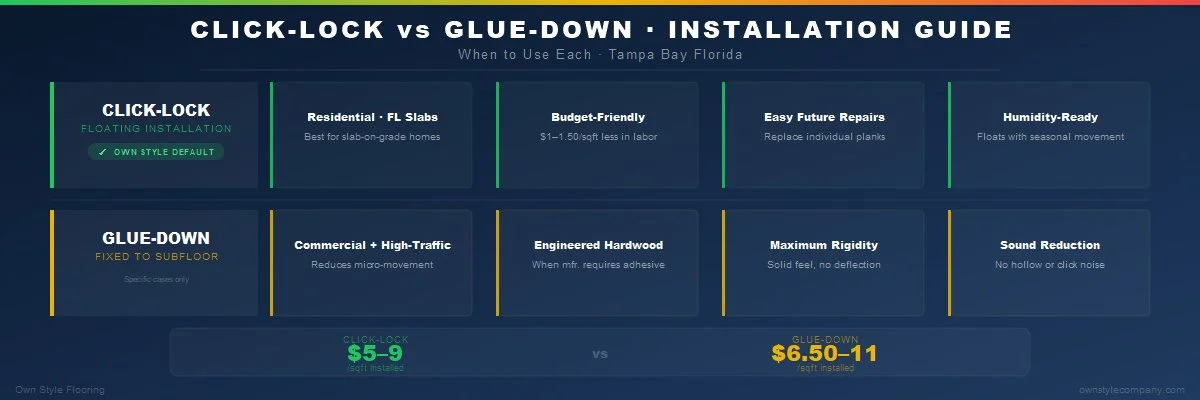
• Lower labor cost: typically $1.00–1.50 per square foot less than glue-down.
What Is Glue-Down Installation?
In glue-down installation, each plank is bonded directly to the subfloor using a flooring adhesive. There is no floating — the floor is fixed. This creates a floor with more rigidity, less deflection underfoot, and a more "solid" feel.
• Stability in high-traffic areas: in commercial spaces with heavy foot traffic, glue-down reduces micro-movement that can eventually loosen click-lock joints.
• Sound reduction: glue-down eliminates the hollow or clicking sound that some floating floors produce.
• No expansion gaps needed: glue-down floors do not require the perimeter expansion gap that floating floors need.
How Does Florida's Humidity Affect Each Method?
Click-lock in Florida humidity
Click-lock handles humidity-driven movement by design. When the floor expands in high humidity, the planks shift slightly as a unit. The critical requirement is that proper expansion gaps are left at all perimeter walls — typically 1/4 inch minimum — to allow for this movement without binding.
Glue-down in Florida humidity
Glue-down on concrete slabs in Florida has specific risks. Adhesive moisture sensitivity is a real concern: Florida slabs that test acceptable in December can exceed the adhesive's moisture limits in August. An adhesive failure results in planks lifting and separating. Removal is also labor-intensive — adhesive residue bonds strongly to concrete.
Which Is Better for Concrete Slabs in Tampa Bay?
For concrete slab installations in Tampa Bay residential homes, click-lock floating installation is the more reliable method in most cases. Florida slabs vary in moisture output by season. Click-lock accommodates this variability without adhesive concerns. If moisture causes a problem, floating floors can be lifted and the moisture source addressed without a full demolition.
What Does Each Method Cost Installed in Tampa Bay in 2026?
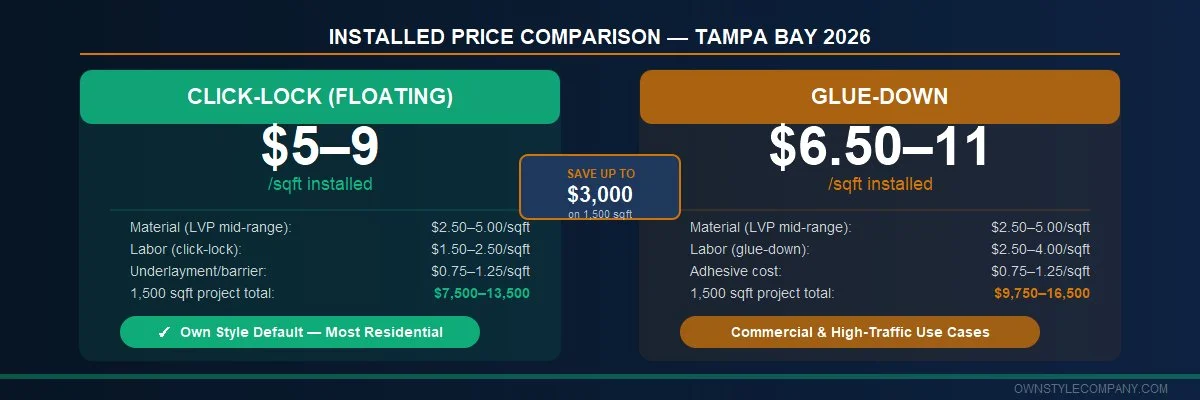
• Click-lock LVP, residential: $5–9 per square foot installed (product + labor).
• Glue-down LVP, residential: $6.50–11 per square foot installed (product + adhesive + additional labor).
• Labor difference only: $1.00–1.50 per square foot. On 1,500 sqft, that is $1,500–2,250 in additional labor for glue-down.
What Does Flooring at Tampa Bay Actually Install and Why?
Our default recommendation for Tampa Bay residential LVP and laminate is click-lock floating installation. The reasons: better long-term performance in Florida's climate, lower cost for the homeowner, easier repair access if any individual plank is damaged, and no adhesive moisture compatibility concerns over Florida slabs.
We install glue-down in specific circumstances: commercial projects with heavy traffic, engineered hardwood where the manufacturer requires it, and situations where the specific product and slab conditions make it the better technical choice. The decision should always be made on-site, based on the subfloor, the product selected, and the room's use. Contact us at operations@ownstylecompany.com or (813) 455-5756, or visit ownstylecompany.com.
FREQUENTLY ASKED QUESTIONS
-
Click-lock installation connects flooring planks to each other using tongue-and-groove locking systems. The floor floats over the subfloor without being attached to it. This allows the floor to expand and contract as a unit in response to humidity and temperature changes — which is important in Florida's climate. It is the most common installation method for LVP and laminate in Tampa Bay residential homes.
-
Glue-down installation bonds each plank directly to the subfloor using adhesive. The floor does not float — it is fixed to the substrate. Glue-down creates a more rigid floor with less deflection, less noise, and a more solid feel underfoot. It is preferred for commercial spaces, high-traffic areas, and some engineered hardwood applications.
-
Click-lock (floating) installation handles Florida's humidity better for most residential applications. Because the floor floats, it can expand and contract as a unit without stressing individual planks. Glue-down installations in Florida can experience adhesive failure if the adhesive is not rated for high-humidity environments or if concrete slab moisture exceeds the adhesive's tolerance.
-
Both can last 20+ years in Tampa Bay when properly installed over a prepared subfloor. Click-lock occasionally develops separation at joints with significant movement, which can be corrected without full replacement. Glue-down installations that fail due to adhesive issues typically require full removal and reinstallation. Subfloor preparation and product quality matter more than the installation method.
-
Click-lock (floating) installation typically costs $1.00–1.50 per square foot less in labor than glue-down. Glue-down requires more preparation time, adhesive cost, and application time. On a 1,500 sqft project, this is a $1,500–2,250 difference. For most Tampa Bay residential projects, click-lock offers the better cost-to-performance ratio.
-
Own Style Flooring recommends click-lock (floating) installation for most Tampa Bay residential LVP and laminate projects. Glue-down is recommended for high-traffic commercial applications and for engineered hardwood over concrete when moisture levels are well-controlled. Contact operations@ownstylecompany.com or (813) 455-5756, or visit ownstylecompany.com for a site-specific recommendation.