How to Measure Concrete Moisture with the Calcium Carbide (CM) Method Before Flooring Installation?
↘️Listen to the podcast on this topic.
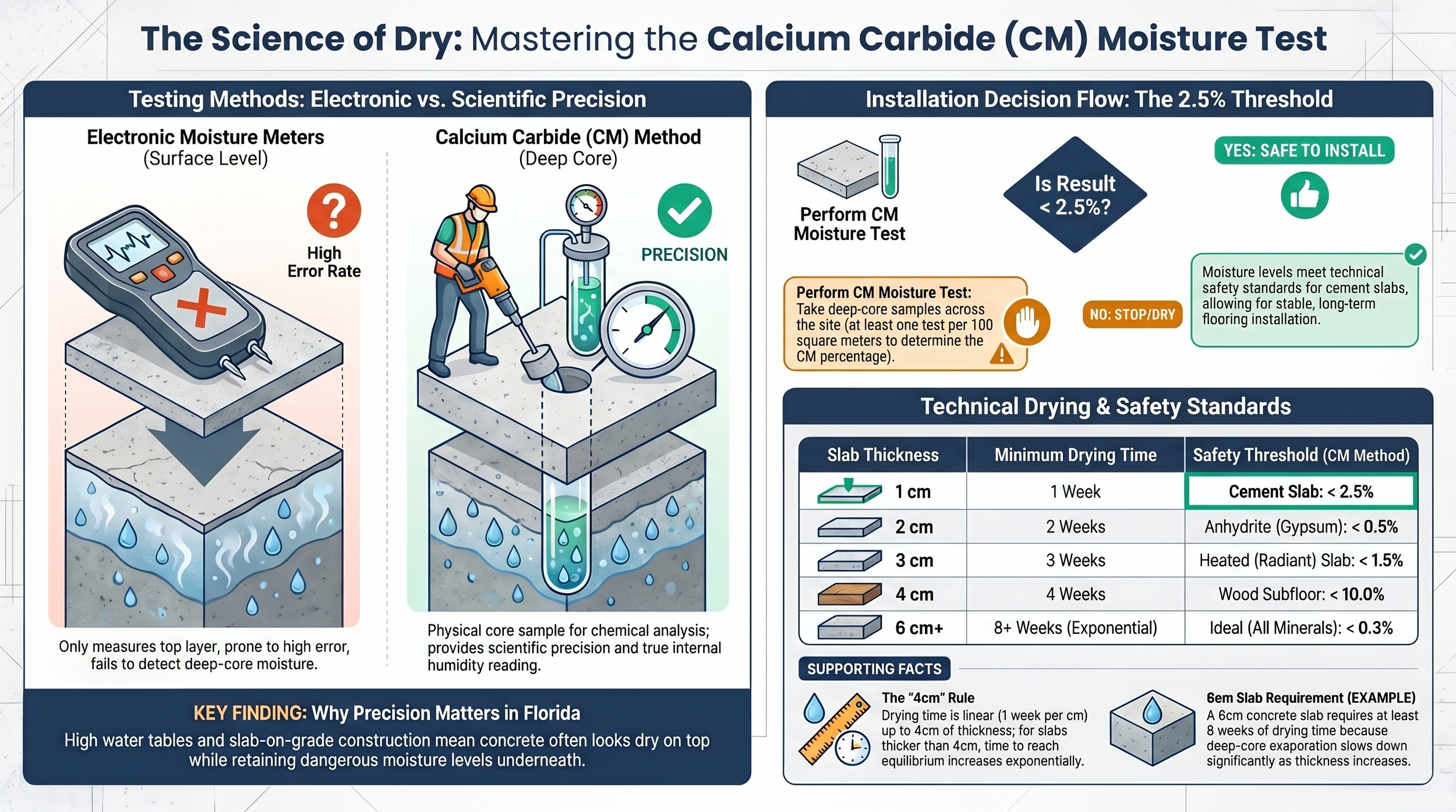
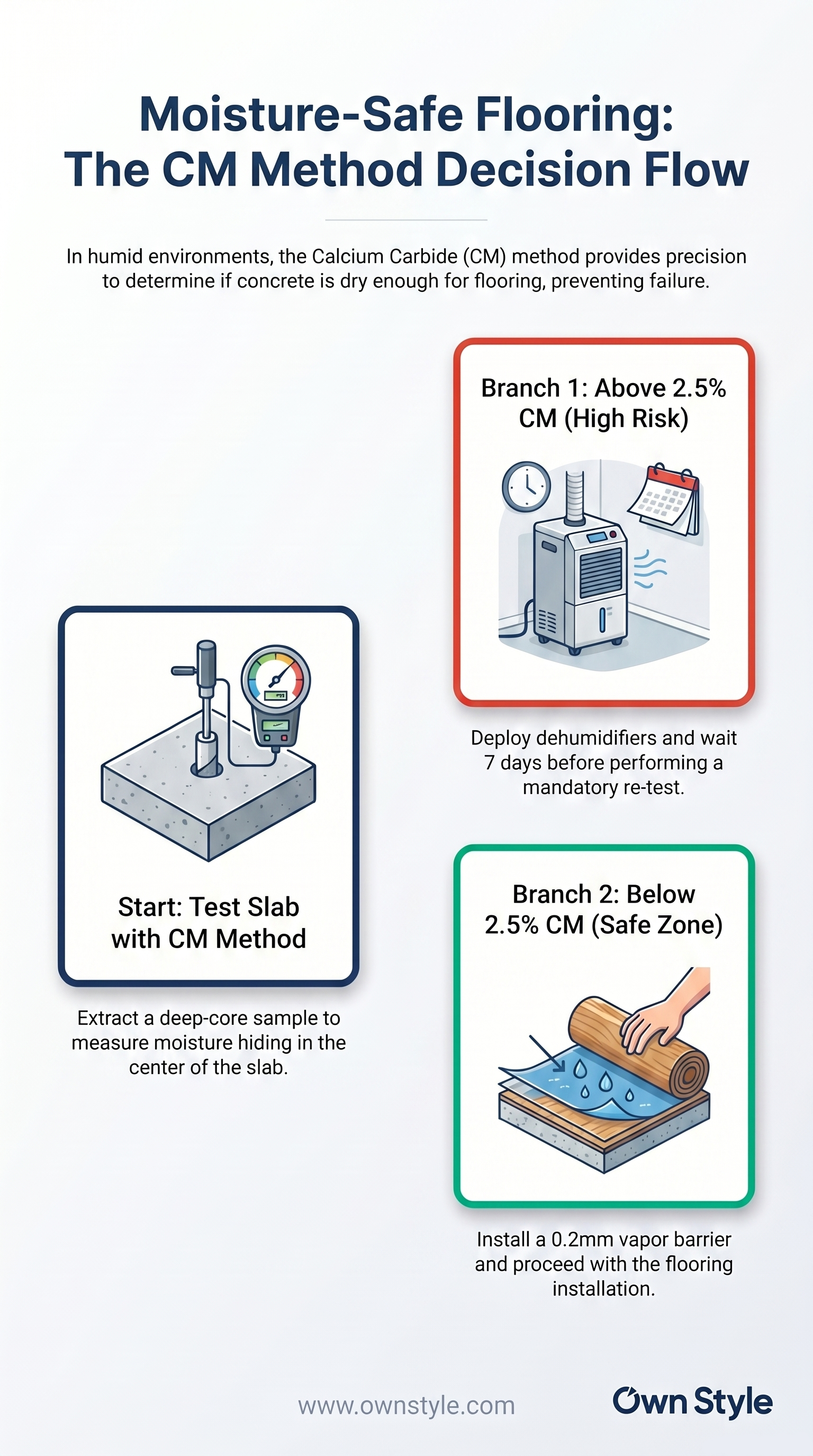
The CM (Calcium Carbide) method is the only scientifically accurate test for measuring deep-core moisture in concrete slabs before laminate flooring installation. It works by extracting a sample from the center of the slab, placing it in a sealed pressure vessel with calcium carbide, and reading the resulting gas pressure on a manometer. A reading above 2.5% CM means the slab is not safe for installation — installing laminate over it will cause warping, joint failure, and voided warranties. In Tampa Bay, where slab-on-grade construction sits above a consistently high water table, skipping this test is the leading cause of post-installation floor failure in the region.
1. The Invisible Risk in Florida Coastal Homes
For homeowners in Brandon, Riverview, and Valrico, the ground beneath your home is a constant source of water vapor. Concrete is naturally porous, acting like a hard sponge that pulls moisture from the soil through capillary action. In the Tampa Bay area, where slab-on-grade construction is the norm, omitting a rigorous subfloor moisture check is the leading cause of post-installation failure. When moisture levels exceed safe thresholds, the High-Density Fiberboard (HDF) core of your laminate planks absorbs the vapor, leading to "peaking" at the joints and structural degradation that no warranty will cover.
2. Why Electronic Meters Often Fail in Tampa
Many DIY enthusiasts and low-cost contractors rely on electronic impedance meters. While these tools are fast, they are easily fooled by Florida’s humidity. On a hot day in Hillsborough County, the surface of a slab might feel dry to the touch because of the air conditioning, while the center of the concrete remains saturated. The CM Method bypasses this error by using a chemical reaction. A physical sample of the concrete is taken from the middle of the slab, mixed with calcium carbide in a pressure vessel, and the resulting gas pressure provides a scientifically precise reading of the internal moisture.
3. The Professional Protocol: How Own Style Flooring Tests Your Slab
At Own Style Flooring, we treat every installation in Seffner and Town 'n' Country with engineering-grade precision. Our testing protocol follows four critical steps:
Deep-Core Sampling: We drill into the concrete to extract a sample from the center of the slab, where moisture hides.
Precision Weighing: The sample is weighed to the gram before being placed in a reinforced steel pressure cylinder.
Chemical Activation: A calcium carbide ampule is crushed inside the vessel. The moisture in the concrete reacts with the carbide to create acetylene gas.
Manometer Reading: We monitor the pressure gauge. If the reading is above 2.5%, we stop the installation. We never risk your home’s aesthetics on a "maybe."
4. Calculating Drying Times in Humid Climates
If you are building a new home or addition in Largo or Clearwater, patience is your best friend. As a rule of thumb, new concrete requires one week of drying time for every centimeter of thickness. For a standard 6cm slab, this means a minimum of 8 weeks under ideal conditions. However, in the high-humidity environment of the Gulf Coast, this process can take longer. Rushing the installation to save a few days often results in having to tear up and replace the entire floor within a year—a cost that far outweighs the price of professional testing.
The Vapor Barrier: Your Second Line of Defense
Even when a slab tests "dry," a professional installation always includes a high-quality moisture shield. We utilize a 0.2mm Polyethylene (PE) film with an SD value greater than 75m. This barrier is non-negotiable in Tampa Bay. It acts as a permanent shield against future fluctuations in the water table or seasonal heavy rains. Without this SD-rated barrier, the moisture from the ground will eventually reach the laminate’s locking system, causing the "clicking" joints to become brittle and eventually snap.
6. Professional Expertise vs. DIY Risks
While the CM test equipment can be rented, it requires precise calibration and a deep understanding of concrete chemistry. By investing in professional installation at $5-9 per square foot, you are not just paying for labor; you are buying insurance against the most common cause of floor failure in Florida. A mistake in moisture testing is a "silent" error—you won't know it happened until your floor begins to rise and crack six months later. At Own Style Flooring, we ensure it’s done right the first time, every time.
FREQUENTLY ASKED QUESTIONS
-
For standard cement slabs in the Tampa Bay area, moisture content must be below 2.5% CM. If you have an anhydrite (gypsum) subfloor, the limit is much stricter at 0.5% CM
-
We do not recommend it for Florida homes. Pin meters only read the top 1/4 inch of the slab. In our coastal climate, the surface can appear dry while the core is still wet, leading to floor failure.
-
Generally, concrete dries at a rate of one week per centimeter of thickness. In high-humidity areas like St. Petersburg or Tampa, you should plan for at least 8 to 12 weeks for a standard residential slab.
-
The planks will swell, the edges will lift (creating a "washboard" effect), and the locking mechanism will eventually break, requiring a full replacement of the floor.
Other interesting topics
Other interesting topics