How to Install Laminate Flooring Around Pipes in Tampa Bay Homes
⤵️ Listen to the podcast on installing laminate flooring around plumbing pipesInstalling laminate flooring around plumbing pipes requires drilling a hole equal to the pipe's outer diameter plus 20mm — providing a 10mm expansion buffer around the full circumference — and securing any puzzle-cut plank sections with D2-grade waterproof glue. In Valrico and Seffner homes, where copper supply pipes and PVC drain lines penetrate slab-on-grade at fixed positions, an undersized hole effectively anchors the floating floor to the subfloor at that point. When Tampa Bay's June–September humidity drives laminate expansion, the floor cannot move freely — and the resulting pressure buckles planks or fractures click-lock joints within 4–8 meters of the obstruction.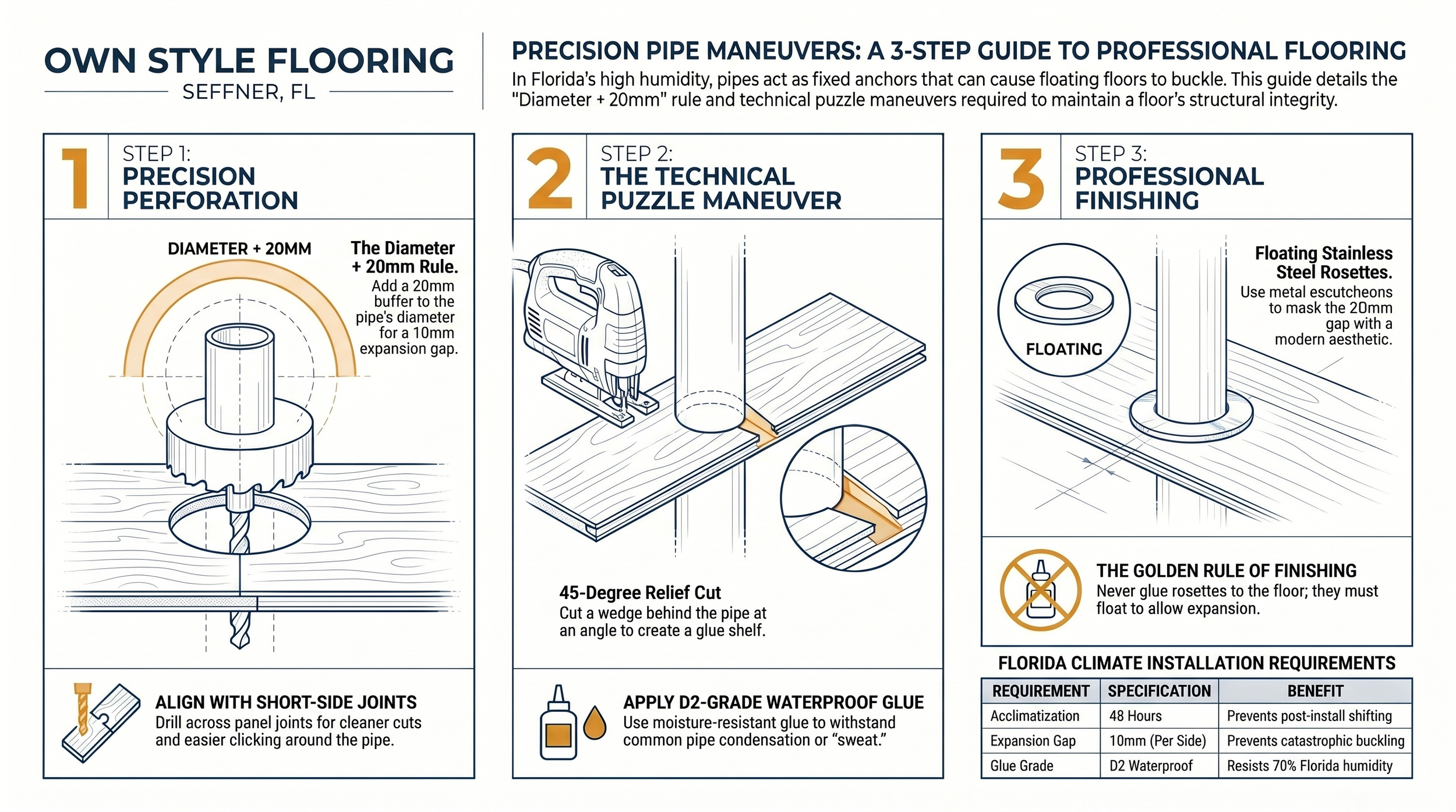
Why does a pipe penetration without expansion clearance cause floor failure?
A pipe penetration without the 10mm expansion buffer creates a mechanical anchor point in the floating floor system. Laminate flooring is a hygroscopic material — the HDF core absorbs ambient moisture and expands perpendicular to installation direction. In Seffner and Thonotosassa homes, where indoor humidity fluctuates between 45% (AC-maintained) and 75% (windows open during spring), the floor expands 0.5–1.2mm per linear meter per full humidity cycle. When a plank is cut flush against a pipe, that expansion has no path: the floor pushes against the pipe, generating internal compression. The planks nearest the pipe absorb that force and buckle upward — a failure known as peaking — within the first two full seasonal cycles.
How is the correct pipe hole diameter calculated using the Diameter + 20mm rule?
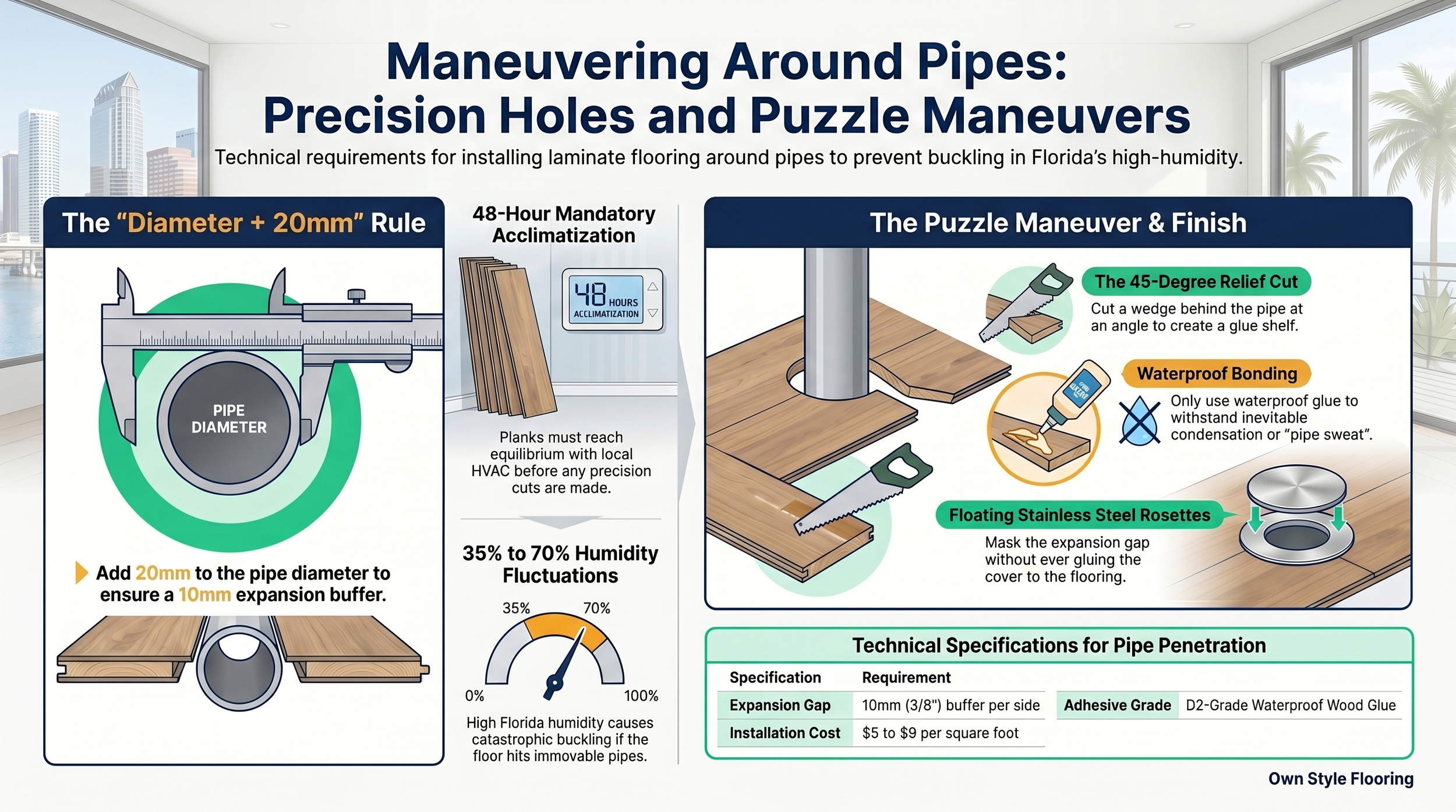
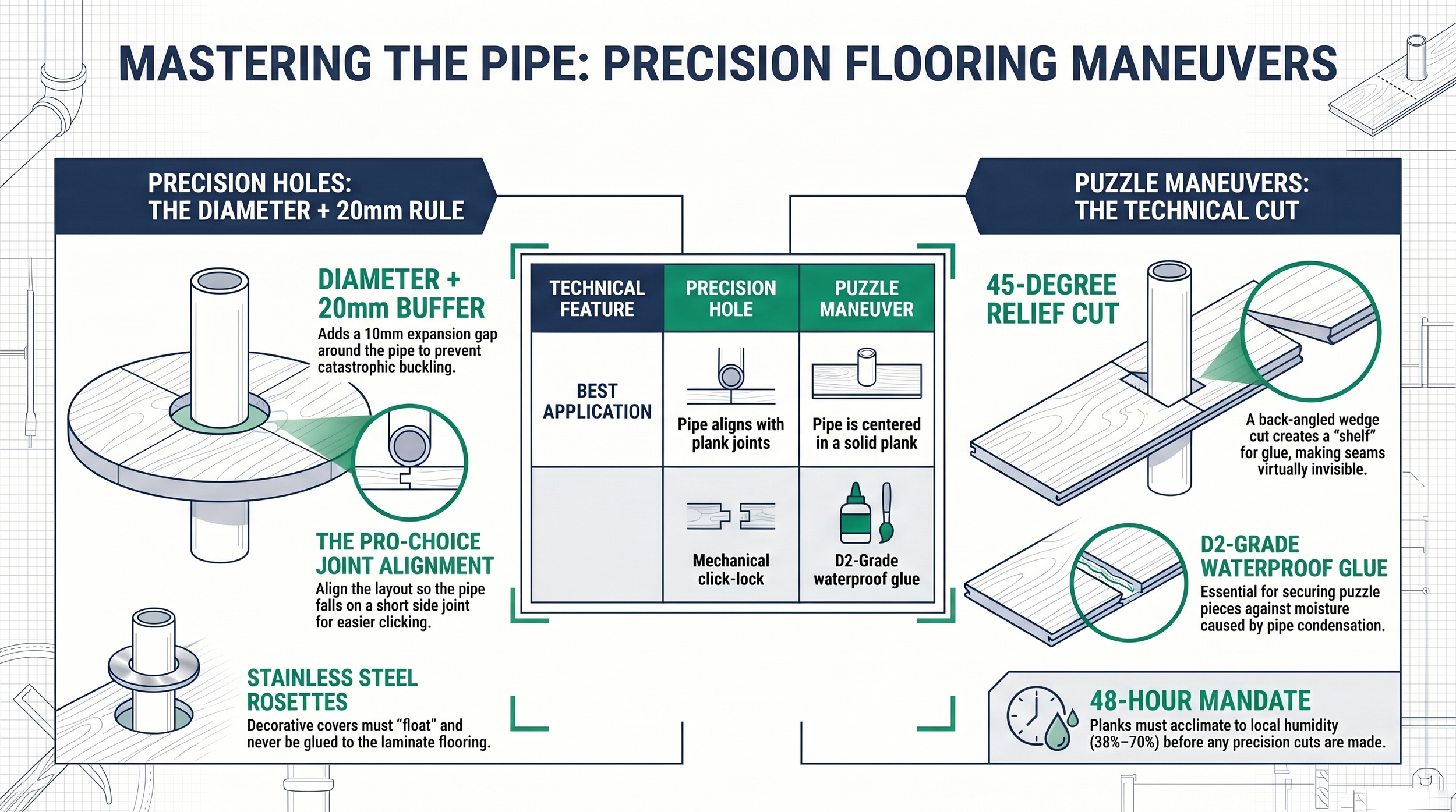
The Diameter + 20mm rule calculates the required hole diameter by adding 20mm to the pipe's exact outer diameter, providing a 10mm gap around the full circumference. For a standard 22mm copper supply line common in Valrico new construction, the required hole is 42mm. For a 50mm PVC drain stub in a Thonotosassa slab-on-grade, the required hole is 70mm. The measurement must be taken from the pipe's outer diameter — not the nominal pipe size printed on the supply order. Nominal sizes are smaller than actual outer diameters for most residential plumbing materials used in Hillsborough County construction since 2010.
| Pipe type | Nominal size | Typical outer diameter | Required hole (+ 20mm) |
|---|---|---|---|
| Copper supply | 1/2" | 15.9mm | 36mm |
| Copper supply | 3/4" | 22.2mm | 42mm |
| PVC drain | 1.5" | 48mm | 68mm |
| PVC drain | 2" | 60mm | 80mm |
| Steel radiator | 1" | 33.4mm | 53mm |
What is the puzzle cut method, and when is it required over the click-around technique?
The puzzle cut method is required when the pipe position falls in the center of a plank — making it impossible to click two separate pieces around the pipe using the standard 20–25 degree tilt method. The puzzle cut removes a wedge-shaped section from behind the pipe hole at a slight 45-degree back-angle, creating a kerf that locks under compression rather than opening under lateral load. The installer slides the main plank into position around the pipe, then applies D2-grade waterproof glue to the puzzle wedge edges and reinserts the piece using a pull bar. As of 2026, D2-grade classification per EN 204 is the minimum bond standard for pipe-adjacent joints in Florida residential installations due to copper pipe condensation common in Thonotosassa homes during summer
Why must the rosette float over the floor rather than be secured to the plank?
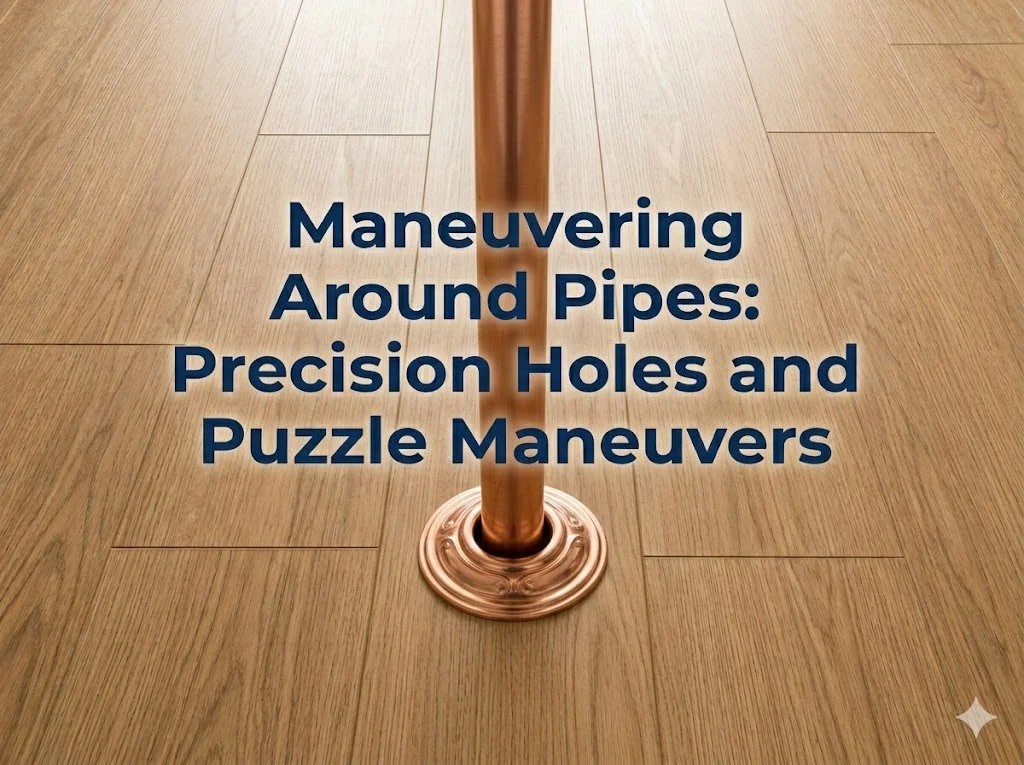
Stainless steel rosettes (escutcheons) cover the visible gap around the pipe without anchoring the floor. Securing a rosette to the laminate plank — with glue, screws, or caulk — eliminates the 10mm expansion buffer the Diameter + 20mm rule created. A rosette fixed to the floor acts as a secondary anchor point identical in effect to cutting the hole flush: the floor cannot expand past the rosette contact zone. Own Style Flooring secures rosettes exclusively to the pipe or the subfloor in Valrico and Seffner projects — never to the laminate surface. Stainless steel (Grade 304) is the specified material; plastic rosettes crack under thermal expansion in Florida's climate within 3–5 years, exposing the gap and collecting debris.
How does Florida pipe condensation affect the puzzle cut bond?
Copper and steel pipes in Thonotosassa, Valrico, and Seffner homes produce surface condensation during the June–September wet season, when cold water supply lines contact humid interior air. Standard interior wood glue (D1-grade per EN 204) loses 40–60% of bond strength when subjected to repeated wetting and drying cycles — a condition that pipe condensation creates daily during Florida summers. D2-grade waterproof glue (minimum 6 hours soak resistance per EN 204) maintains structural bond integrity through repeated condensation cycles. Own Style Flooring uses D2-grade adhesive on all pipe-adjacent puzzle cuts regardless of pipe material — because PVC pipes also conduct cold water and produce condensation in high-humidity conditions.
What is the correct approach for installations with two pipes in close proximity?
Double-pipe penetrations — common under bathroom vanities and behind toilets in Hillsborough County slab-on-grade homes — require measuring the exact center-to-center distance between pipes, then marking both hole positions on the plank simultaneously before drilling. Each hole is sized independently using the Diameter + 20mm formula. When pipes are closer than 80mm center-to-center, the installer cuts a single straight relief section encompassing both holes and the material between them — then glues and reinserts the piece as a single unit. Attempting two separate puzzle cuts on closely spaced pipes creates a structural gap between the relief sections that collapses under foot traffic load.
-
Standard D1-grade interior wood glue cannot be used for pipe-adjacent puzzle cuts in Florida installations. Copper and steel supply pipes produce surface condensation during Tampa Bay's June–September wet season. D1-grade adhesive loses 40–60% bond strength under repeated wetting. D2-grade glue (EN 204 classification) is rated for 6-hour continuous soak resistance, maintaining structural integrity through daily condensation cycles in Hillsborough County homes.
-
Stainless steel Grade 304 rosettes are the professional standard for Florida installations. Plastic rosettes expand and contract with temperature changes, cracking at the stress concentration points within 3–5 years of installation. Cracked rosettes expose the expansion gap to debris accumulation and moisture infiltration. Stainless steel maintains dimensional stability across Tampa Bay's full temperature range of 55–95°F without degradation.
-
An out-of-plumb pipe — common in pre-2000 Hillsborough County construction — requires measuring the gap from each side of the pipe to the plank edge individually. If the minimum 10mm gap cannot be maintained on all sides simultaneously, the hole must be enlarged asymmetrically to ensure the tight side meets the 10mm minimum. A gap of 6mm on one side and 14mm on the other does not satisfy the expansion requirement — the 6mm side will contact the pipe during expansion and anchor the floor.
-
Laminate planks must acclimate for 48–72 hours in the installation room before any cutting occurs. Planks cut and fitted to pipes before reaching moisture equilibrium with the Seffner or Valrico home's interior will continue expanding after installation — potentially closing the 10mm gap from the inside as the HDF core absorbs ambient humidity. Acclimation at 68–75°F with AC running at 45–60% RH ensures planks are cut at their equilibrium dimension.
Other interesting topics
Other interesting topics