The One-Third Staggering Rule: Why Joint Offset Prevents Floor Failure in Tampa Bay
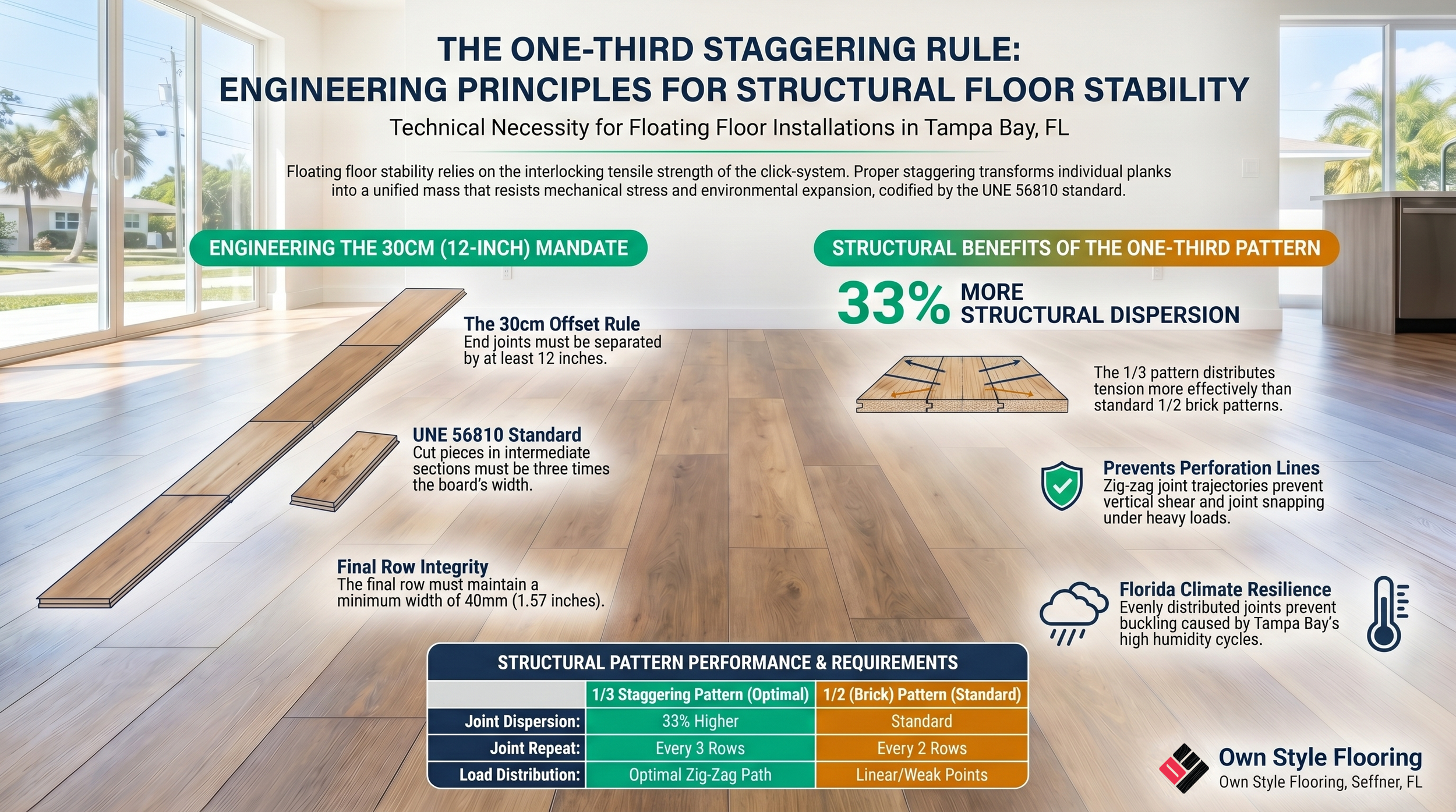
⤵️ Listen to the podcast on the one-third staggering rule and floor stabilityThe one-third staggering rule requires that end joints in adjacent laminate rows are offset by at least 30cm (12 inches), with no two joints aligning within three consecutive rows — a pattern codified in UNE 56810 standard, Point 5. In Riverview and Brandon homes, where floating floors expand and contract as a unified mass through Tampa Bay's daily humidity cycles, correct stagger distributes structural load across the entire floor surface. Poor stagger creates perforation lines — linear weak zones where click-lock joints concentrate expansion force until the tongue-and-groove profile fractures under foot traffic or furniture weight.
Why does a floating floor depend on joint geometry rather than adhesive for stability?
A floating floor derives stability from collective mass, friction against the subfloor, and the interlocking tensile strength of the click-lock system — not from any mechanical bond to the subfloor surface. In Brandon and Riverview homes, this assembly functions as a single structural diaphragm only when joints are correctly offset. Each plank transfers load laterally to its neighbors through the click profile. When joints are staggered correctly, a localized load — such as a 200-lb piece of furniture — disperses across 6–8 adjacent planks. When joints align, that same load concentrates on a single click interface, exceeding the 0.5mm lateral tolerance of standard Uniclic profiles.
What does the 30cm minimum offset rule require under UNE 56810?
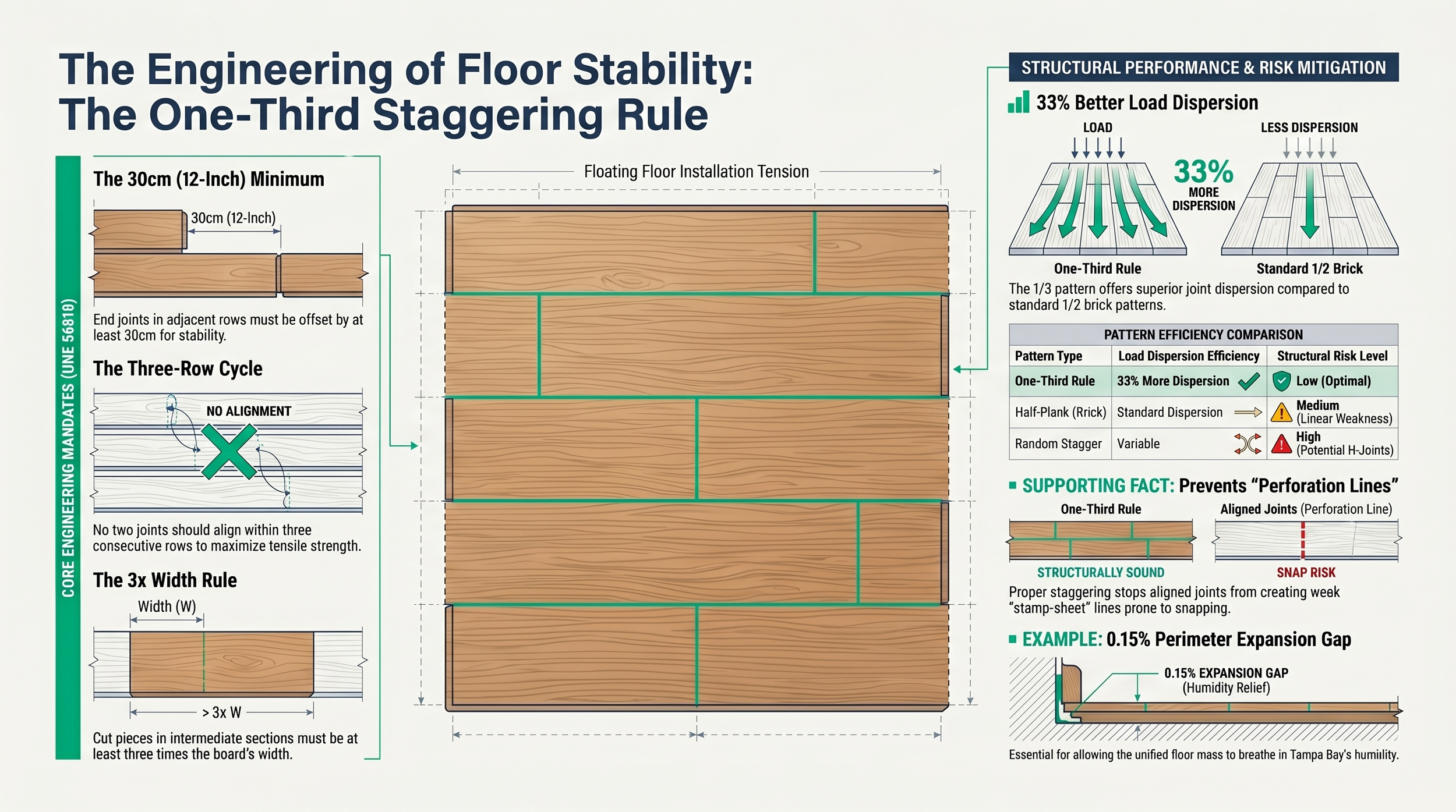
UNE 56810 Point 5 mandates a minimum 30cm (12-inch) offset between end joints in adjacent rows, with no alignment within three consecutive rows. The standard also requires that cut pieces used for intermediate rows have a length of at least three times the plank width to maintain structural leverage — typically a minimum of 36–45cm for standard 120–150mm-wide planks. The final row must not measure less than 40mm (1.57 inches) in width; if preliminary calculations produce a narrower remainder, the first row must be pre-trimmed so the first and last rows balance at equal widths. As of 2026, these requirements apply to all floating laminate installations in Florida residential properties.
| Stagger requirement | UNE 56810 specification | Minimum value |
|---|---|---|
| Joint offset between adjacent rows | Point 5 | 30cm (12 inches) |
| Cut piece minimum length (intermediate rows) | Point 6 | 3× plank width |
| Final row minimum width | Professional protocol | 40mm (1.57 inches) |
| Subfloor level tolerance | DIN 18202 / UNE 56810 | 2mm over 1m span |
How do H-joints and perforation lines form, and where do they fail first?
H-joints form when end joints in every other row align in the same position — creating a continuous "H" shape across two adjacent rows visible from above. Perforation lines form when small, repeated offsets (under 10cm) create a diagonal chain of closely spaced joints across multiple rows. Both defects create paths of minimum resistance through the floor diaphragm. In Lithia and Fishhawk Ranch homes — where open-plan layouts create floors exceeding 40 sqm — H-joints and perforation lines fail first in the center of the room, where perimeter expansion gaps provide no structural relief and dynamic loads from foot traffic apply maximum leverage on the affected joints.

Why is the one-third pattern structurally superior to the brick (half-plank) pattern?
The one-third pattern requires three complete rows to repeat a joint cycle, forcing each joint line to take a long zig-zag path across the floor. The brick pattern (1/2 offset) repeats every two rows, creating joint alignment opportunities twice as frequently. Engineering analysis of HDF floating floors shows the one-third pattern provides 33% more joint dispersion than the brick pattern under equivalent dynamic loads — meaning the path a fracture or separation must travel is 33% longer before reaching another joint line. For Tampa Bay homes where the floor operates as a single thermal mass through seasonal humidity swings of 30–80% RH, the one-third pattern's superior dispersion reduces joint fatigue by limiting the number of planks subject to simultaneous stress concentration.
How does Tampa Bay's humidity amplify the consequences of poor stagger?
Tampa Bay's relative humidity averages 74% annually and peaks above 80% during June through September, according to 2026 NOAA data for Hillsborough County. A floating laminate floor in Riverview responds to these cycles as a unified mass: every plank expands toward the perimeter simultaneously, generating internal compression forces that the click-lock system must absorb. In a correctly staggered floor, those forces distribute across hundreds of overlapping joints. In a floor with H-joints or perforation lines, the same forces concentrate at the aligned joint positions — producing peaking (vertical lifting at the joint) or horizontal gap opening within 6–18 months of the first wet season. Flooring's at Tampa Bayinstallation protocol in Hillsborough County requires one-third stagger on all floating installations regardless of room size.
What subfloor conditions cause correct stagger to fail prematurely?
A correctly staggered floor fails prematurely when the subfloor exceeds the 2mm tolerance over a 1-meter span required by DIN 18202 and UNE 56810. High spots create concentrated contact pressure between the plank back and the subfloor surface, generating micro-movement at the click joints with every footstep. In Riverview and Brandon homes with slab-on-grade construction, subfloor moisture exceeding 2.5% CM (Carbide Method) further compromises click-joint integrity by causing HDF core swelling that exceeds the stagger geometry's designed tolerances.Flooring at Tampa Bay conducts CM moisture testing on all concrete subfloors before installation — a step that eliminates the most common cause of stagger failure in Hillsborough County projects.
FAQ
-
UNE 56810 Point 5 requires a minimum 30cm (12-inch) offset between end joints in adjacent rows, with no joint alignment within three consecutive rows. Cut pieces used in intermediate rows must be at least three times the plank width in length. In Brandon and Riverview homes, the one-third pattern (400mm offset for standard 1200mm planks) satisfies this requirement with geometric precision.
-
Cut-off pieces can start the next row if they meet two conditions: minimum 30cm length and — for intermediate rows — a length at least three times the plank width per UNE 56810 Point 6. A 25cm off-cut from the end of a row cannot be reused. Reusing pieces that are too short is the most common source of H-joints in DIY installations in Hillsborough County homes.
-
A final row narrower than 40mm (1.57 inches) lacks the structural depth to maintain click engagement with the previous row under lateral expansion forces. In Riverview open-plan homes, where floors spanning 8+ meters generate cumulative expansion forces, a thin final row delaminates from its neighbor within one full seasonal cycle. If preliminary layout calculations produce a final row under 40mm, trim the first row equally so both the first and last rows share the remainder width.
-
The staggering pattern does not change the perimeter gap calculation. The gap is calculated at 0.15% of the room's total dimension in the installation direction, with an absolute minimum of 12mm for rooms exceeding 8 meters per UNE 56810. The stagger manages internal joint geometry; the perimeter gap manages the floor diaphragm's room to expand toward the walls. Both are independent requirements — and both are mandatory in Tampa Bay's humidity environment.
-
A floor with H-joints or sub-30cm offsets develops peaking — vertical lifting at joint lines — within 6–18 months in Tampa Bay's climate. As June–September humidity pushes above 80%, the entire floating mass expands simultaneously. Correctly staggered floors absorb that expansion through distributed joint compression. Poorly staggered floors concentrate expansion force at the aligned joint positions, pushing planks upward or forcing horizontal gaps that harbor moisture and accelerate HDF core degradation.
Other interesting topics
Other interesting topics