Which Vinyl Flooring Handles Florida Heat? The Comparison Tampa Bay Homeowners Need
Double-click to edit...
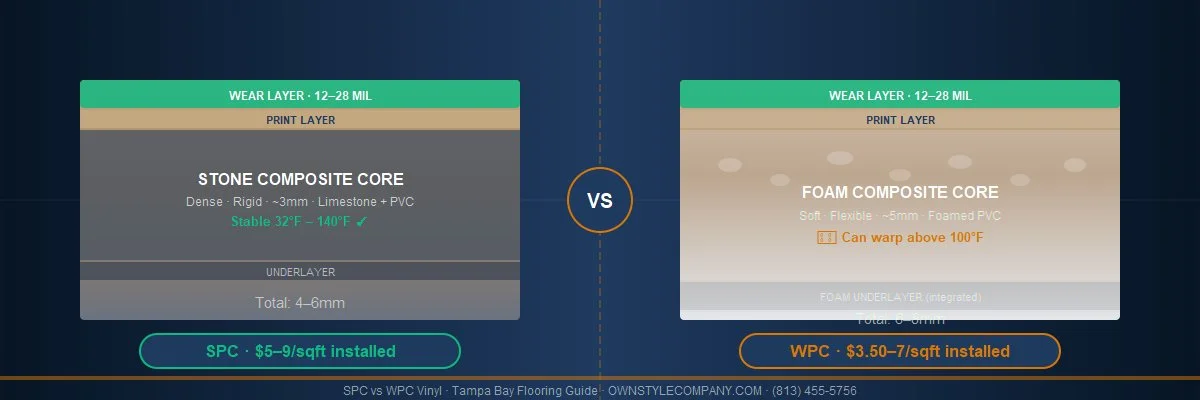
SPC vs WPC Vinyl in Tampa Bay: The Difference That Costs You $2/sqft
SPC (Stone Plastic Composite) and WPC (Wood Plastic Composite) are both 100% waterproof luxury vinyl flooring products. From the top, they can look identical. But beneath the wear layer, the core material is completely different — and in Tampa Bay's climate, that core is what determines how long your floor lasts and how well it performs under daily heat, humidity, and AC cycling.
The short answer: SPC has a denser, harder core that outperforms WPC in Florida's temperature extremes and high-humidity conditions. WPC is softer and more comfortable underfoot, making it a better fit for interior rooms with consistent climate control. The $2 per square foot price difference is real, but the right choice depends entirely on where you are installing.
What Is SPC Vinyl Flooring?
SPC stands for Stone Plastic Composite. The core is made from limestone powder, polyvinyl chloride, and stabilizers — a dense, rigid material that gives the floor its structural strength. SPC has almost no flexibility, which is one of its primary advantages: it does not expand or contract meaningfully with temperature or humidity changes.
• Temperature tolerance: typically rated from 32°F to 140°F — covers garage and sunroom conditions in Tampa Bay.
• Dimensional stability: minimal expansion and contraction under Florida's humidity fluctuations.
• Feel underfoot: harder than WPC. Some homeowners notice the difference in bare feet.
• Price: typically $3–5 per square foot for product only; $5–9 installed in Tampa Bay.
What Is WPC Vinyl Flooring?
WPC stands for Wood Plastic Composite. Despite the name, there is no actual wood in most modern WPC flooring. The core is a foamed PVC material that is lighter and slightly flexible, giving WPC its most appealing characteristic: it is warmer and softer underfoot than SPC.
• Temperature sensitivity: WPC can expand in high-heat spaces. In enclosed garages or sunrooms that reach 120°F+, warping can occur.
• Comfort: the foam core absorbs more impact than SPC — better for long periods of standing.
• Sound absorption: WPC is quieter underfoot — less hollow click sound when walking.
• Price: typically $2–4 per square foot for product only; $3.50–7 installed in Tampa Bay.
How Do SPC and WPC Perform in Florida's Heat and Humidity?
Non-conditioned spaces (garages, sunrooms, Florida rooms)
Garages and sunrooms can reach 110–130°F in summer. WPC's foam core can soften and deform at sustained temperatures above 100°F. SPC's stone core maintains its shape through these conditions. If any part of your installation is in a non-conditioned space, SPC is the only appropriate choice.
Daily AC cycling
Tampa Bay homes cycle humidity between 40% and 80% RH daily in summer. SPC's dimensional stability means it does not respond to these swings. WPC can show slight expansion and contraction over time, though it is significantly more resistant than laminate or hardwood.
Which Performs Better in Specific Rooms?
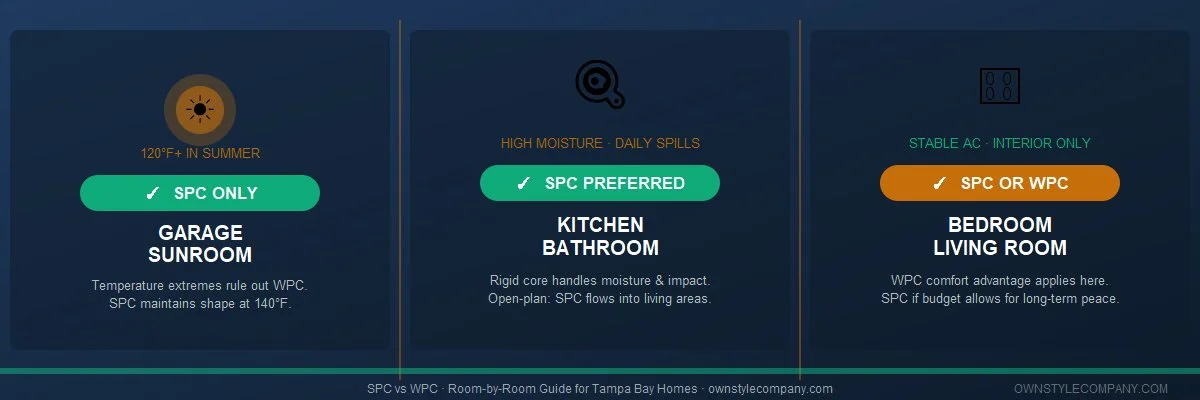
• Kitchens and bathrooms: SPC. Rigid core handles spot moisture and temperature variations better.
• Bedrooms and living areas with consistent AC: either works well. WPC's comfort advantage becomes relevant here.
• Garages, sunrooms, Florida rooms: SPC only. Temperature swings in these spaces will compromise WPC over time.
• Multi-room installation across living areas and kitchen: SPC for visual continuity and consistent performance.
Does the $2/sqft Difference Actually Matter?
On a 1,500 square foot installation, a $2 per square foot difference in material cost is $3,000. In our experience across Tampa Bay installations, WPC fails sooner than expected almost always in spaces with inconsistent climate control or temperature spikes. If you have a fully conditioned home with consistent AC and your installation is interior-only, WPC can serve you well for 15–20 years at lower cost.
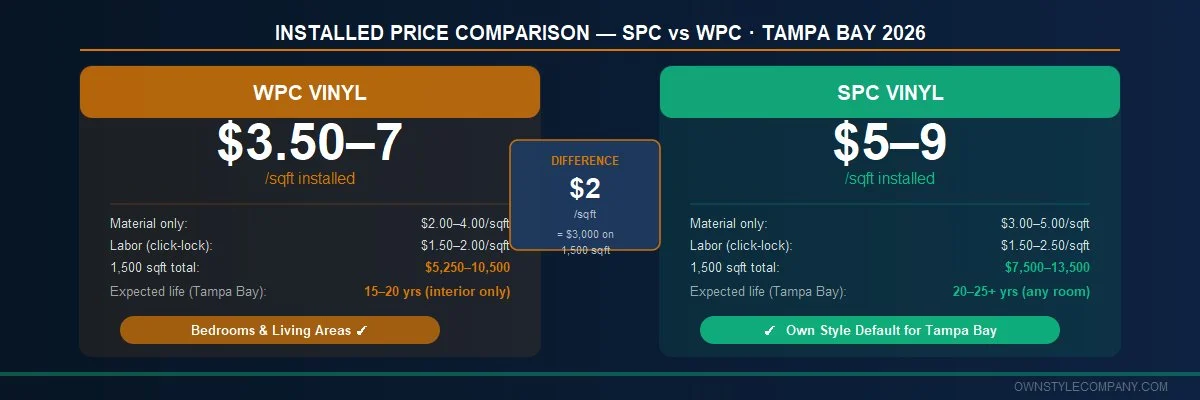
If your installation spans any non-conditioned areas, the $3,000 difference buys significant protection against premature failure.
Which One Does Own Style Flooring Recommend for Tampa Bay?
Our default recommendation for Tampa Bay homeowners is SPC. Tampa Bay's climate is simply harder on flooring than most of the country. SPC's dimensional stability is the right specification for these conditions. Most customers underestimate how hot their non-conditioned spaces get — and WPC installed in a space that proves too hot creates a warranty claim that is hard to resolve.
That said, WPC is an excellent product in the right application. For interior-only bedrooms or living areas in fully conditioned homes, WPC delivers excellent comfort at lower cost. Own Style Flooring installs both products and will always recommend based on your specific conditions. Contact us at operations@ownstylecompany.com or (813) 455-5756, or visit ownstylecompany.com.
FREQUENTLY ASKED QUESTIONS
-
SPC (Stone Plastic Composite) has a rigid core made from limestone powder, PVC, and stabilizers — denser, harder, and more temperature-stable than WPC. WPC (Wood Plastic Composite) has a foamed core that is softer and more comfortable underfoot but less resistant to extreme heat. Both are 100% waterproof.
-
For most Tampa Bay homes, SPC is the better choice. Its rigid core handles Florida's temperature swings, high humidity, and AC cycling more consistently than WPC. WPC works well in bedrooms and living areas with stable climate control, but in garages or sunrooms with temperature spikes, SPC is significantly more stable.
-
For most Tampa Bay homes, SPC is the better choice. Its rigid core handles Florida's temperature swings, high humidity, and AC cycling more consistently than WPC. WPC works well in bedrooms and living areas with stable climate control, but in garages or sunrooms with temperature spikes, SPC is significantly more stable.
-
The price difference reflects the denser limestone-filled core material and additional manufacturing complexity. Over the life of the floor in a Florida home, the durability advantage of SPC typically justifies the premium — especially in high-traffic or temperature-variable spaces.
-
Yes. SPC vinyl is the right choice for garages and sunrooms in Tampa Bay. Its temperature tolerance is typically rated from 32°F to 140°F, covering the extremes in Florida enclosed spaces. WPC can expand and develop ridges in spaces that heat significantly when AC is not running.
-
For residential homes with normal foot traffic, a 12 mil wear layer is the minimum. Homes with large dogs, children, or heavy traffic should use 20 mil. Commercial or mixed-use spaces should use 28 mil or higher. The wear layer protects against scratches and abrasion — not the core material.
-
Yes. Own Style Flooring installs both SPC and WPC vinyl throughout the Tampa Bay area, including Brandon, Riverview, Seffner, and South Tampa. Contact operations@ownstylecompany.com or (813) 455-5756, or visit ownstylecompany.com.