Why Underlayment Thickness Cannot Exceed 3mm for Laminate Flooring in Tampa Bay
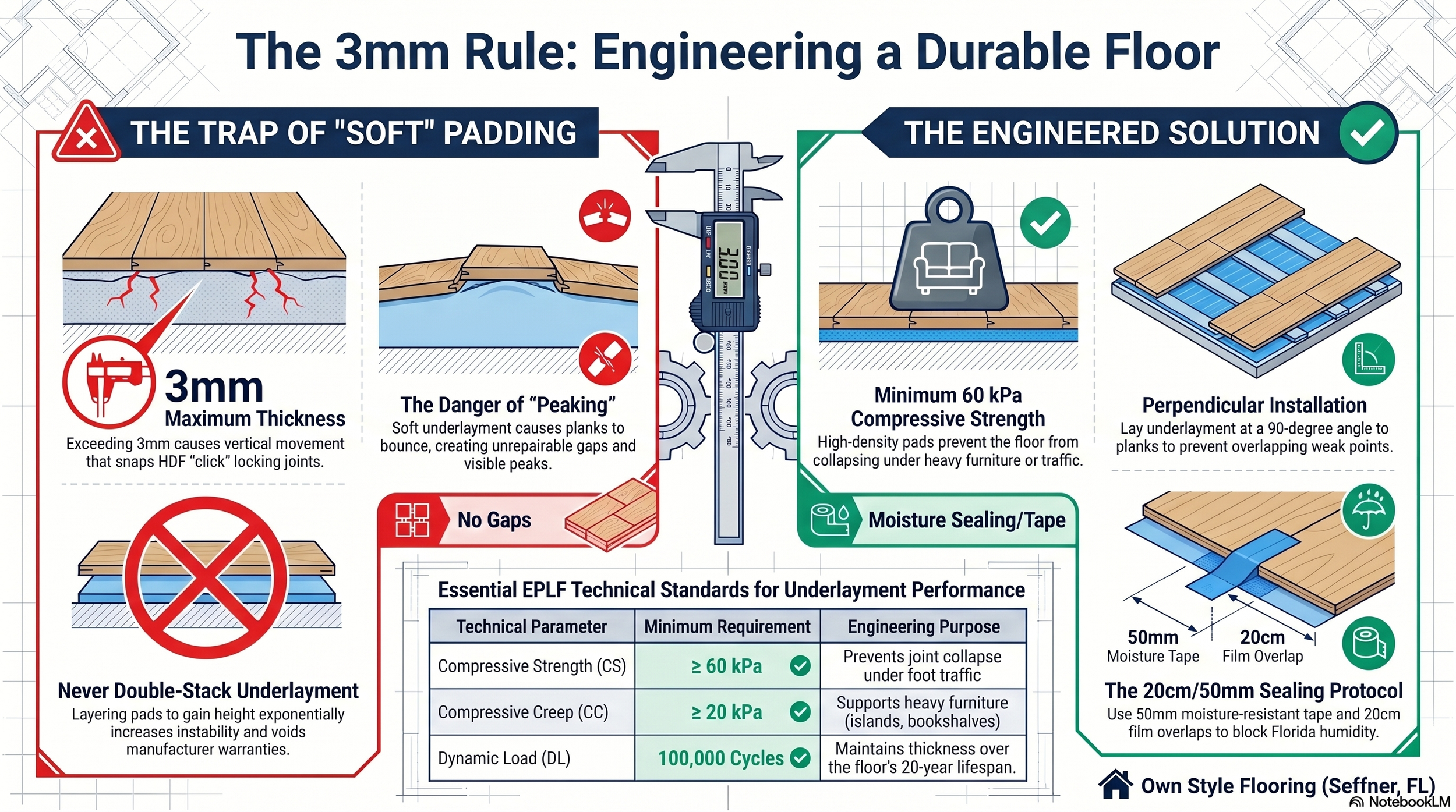
⤵️ Listen to the podcast on underlayment engineering and the 3mm limitLaminate underlayment must not exceed 3mm in thickness and must meet a minimum compressive strength (CS) of 60 kPa — two parameters that directly determine whether a click-lock system survives normal residential use. In Riverview and New Tampa homes, where $5–9 per square foot laminate installations are common, a thicker or softer underlayment feels comfortable under the first step and destroys the Uniclic locking system within months. As the underlayment compresses under foot load, click joints lose their bearing surface and begin moving vertically with each step, producing creaking and, eventually, fractured locking tongues.
What Does "Compressive Strength" Mean for Flooring Underlayment?
Compressive strength (CS) measures how much load an underlayment can absorb before permanently deforming. A CS of 60 kPa is the minimum required for residential laminate installations per European Product Standard EN 13318. An underlayment with CS below 60 kPa — common in generic foam rolls sold at Tampa Bay home improvement stores — compresses past its recovery point under foot traffic, reducing from 3mm to 1.5mm within 6–12 months. At that reduced thickness, the click joint has moved 1.5mm vertically from its engineered position, which is 15 times the joint's tolerance of 0.1mm. The result is a floor that creaks, rocks, and eventually separates at every joint.
Why Does a Softer Underlayment Feel Better But Fail Faster?
Soft foam underlayment — 5mm or 6mm rolls with CS below 40 kPa — creates the sensation of walking on a cushioned surface that homeowners in Wesley Chapel and Land O' Lakes often request. The problem is that laminate is a rigid floating system, not a suspended one. Every millimeter of underlayment compression under load translates directly into vertical deflection of the locked planks. When a 19cm-wide plank deflects 2mm at its center, the click profile bends at an angle of approximately 0.6 degrees — six times the elastic limit of HDF-core locking tongues. Soft underlayment does not just reduce comfort over time; it schedules click-system failure at a predictable rate from the first day of use.
What Technical Specifications Should Underlayment Meet for Tampa Bay Installations?
| Parameter | Specification | Meaning in Practice |
|---|---|---|
| CS — Compressive Strength | ≥ 60 kPa | Resists foot load without permanent compression |
| CC — Compressive Creep | ≥ 20 kPa | Supports heavy furniture (bookcases, stone counters) without flattening |
| DL — Dynamic Load | ≥ 100,000 cycles | Survives normal residential foot traffic over 20 years |
| PC — Punctual Conformability | ≥ 0.5mm | Absorbs concrete micro-irregularities without telegraphing |
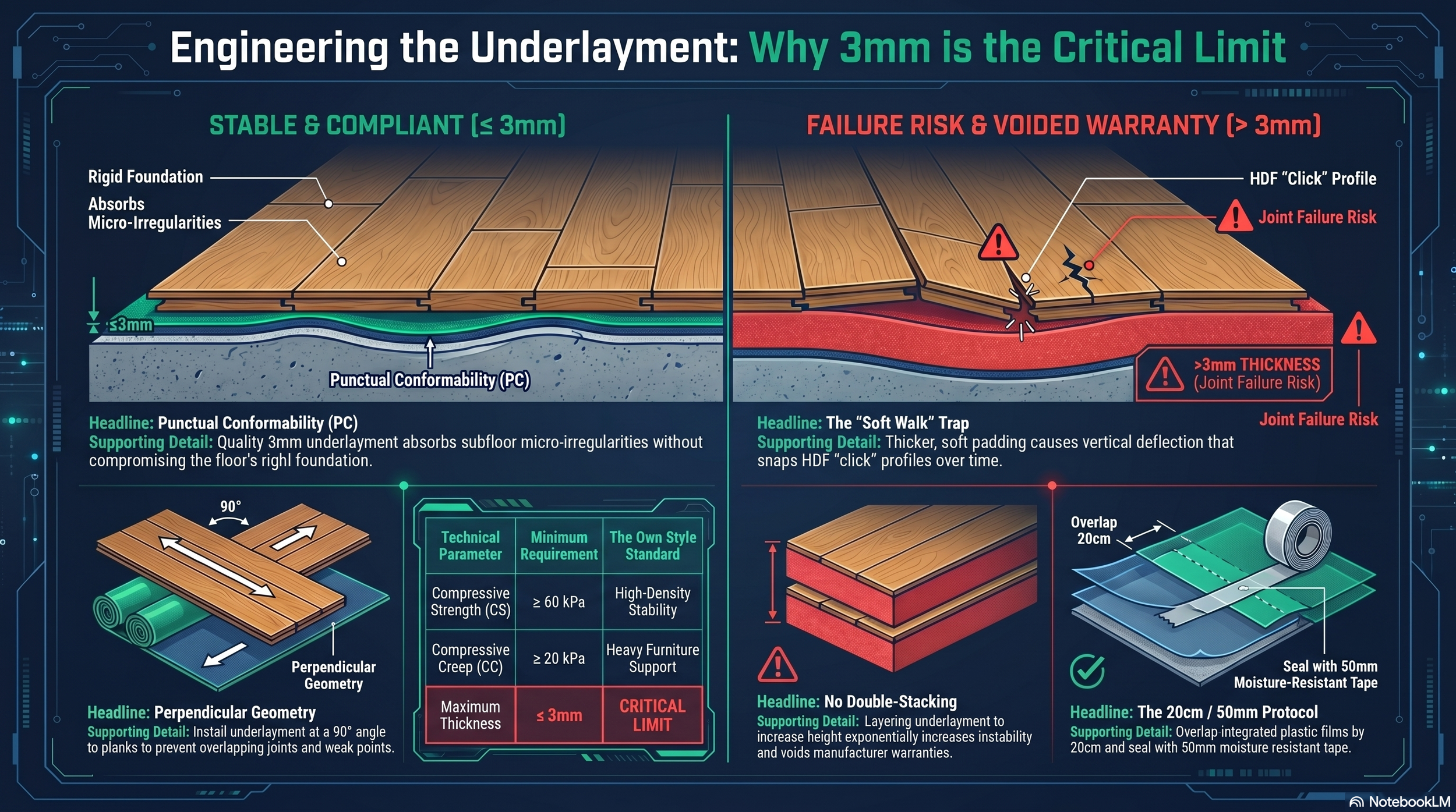
| Maximum thickness | ≤ 3mm | Keeps click joint within its designed bearing tolerance |
As of 2026, Own Style Flooring specifies underlayment meeting all five parameters on every Hillsborough County and Pasco County installation. Generic rolls labeled only with acoustic ratings (dB) without CS and CC values do not meet installation standards and are returned to the supplier.
Why Must Underlayment Be Installed Perpendicular to the Planks?
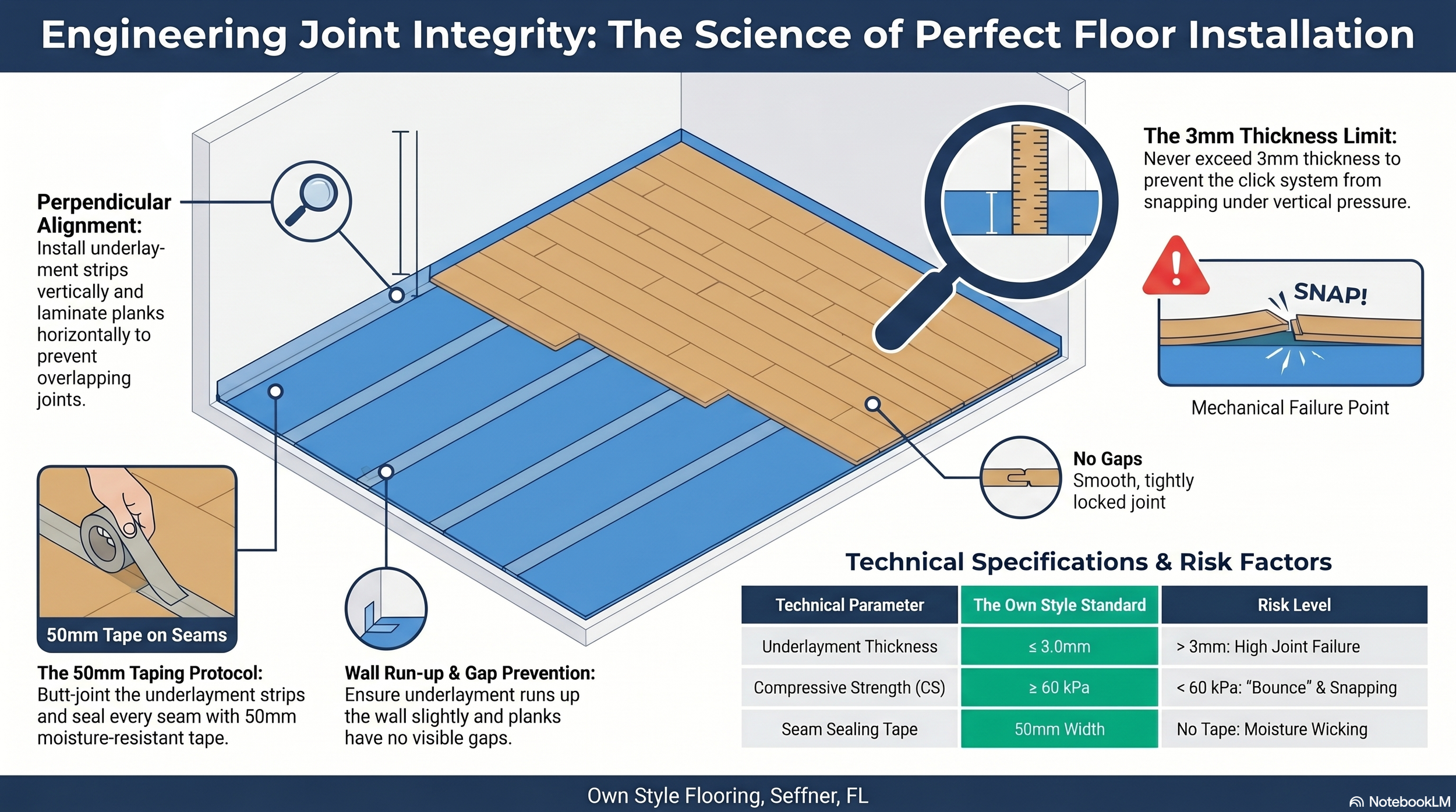
Underlayment strips run perpendicular (90 degrees) to the laminate plank direction on every Own Style Flooring installation in Lutz and Land O' Lakes. This geometry prevents the longitudinal seams of the underlayment from aligning with the long joints of the laminate above. When underlayment seams and plank joints run parallel and overlap, the floor loses its bearing foundation in those specific rows — creating a linear soft zone where the click system fails under point loads. Perpendicular installation also ensures that micro-irregularities in the concrete subfloor are bridged rather than followed, giving the PC conformability value its maximum corrective effect.
What Is the Correct Seam Sealing Protocol for Tampa Bay Underlayment?
In Hillsborough County's coastal environment, underlayment functions as a secondary moisture management layer in addition to its mechanical role. The correct protocol positions strips butt-jointed (edges touching, not overlapping the foam), which prevents height discontinuities that telegraph through the laminate. When the underlayment includes an integrated polyethylene film vapor retarder, the film must overlap the adjacent strip by 20cm and be sealed with 50mm moisture-resistant tape. This creates a continuous barrier against the vapor transmission common in slab-on-grade construction throughout Tampa Bay. In June through September, when outdoor humidity reaches 80%+ in Pasco County, an unsealed underlayment seam allows enough moisture migration to elevate HDF moisture content by 0.3–0.5% — sufficient to initiate edge swelling within one humid season.
FAQ
What Happens When Underlayment Is Double-Stacked?
Double-stacking underlayment — placing two layers of 2mm foam to gain height at a threshold or increase insulation — is the fastest path to manufacturer warranty voidance in a Tampa Bay home. Two 2mm layers create a 4mm compressed bed with cumulative CS well below 60 kPa, making the click system unstable from the first day. The increased cushioning effect magnifies vertical joint deflection under dynamic loads by a factor of 2.5x compared to a single 3mm layer. If height gain is needed at a doorway transition, the correct solution is a feather-finish leveling compound on the subfloor or a transition to a thicker laminate plank profile — never additional underlayment.
Can Underlayment Replace Subfloor Leveling in Tampa Bay Homes?
No. Underlayment with a PC value of 0.5mm corrects minor concrete texture — dust, fine aggregate, or hairline surface irregularities. Underlayment does not correct planimetry defects. Any subfloor deviation exceeding 2mm over a 1-meter span — measured with a straightedge across the slab — requires a self-leveling or feather-finish compound before underlayment is placed. In older Tampa Bay homes in Seffner and Valrico, where slab settlement is common, Own Style Flooring verifies subfloor planimetry with a 1.8-meter aluminum rule before material delivery. Installing 3mm underlayment over a 5mm dip creates a 5mm dip in the finished floor, not a flat surface.
-
No. A 5mm underlayment with adequate thermal resistance (R-value) still exceeds the 3mm mechanical limit for laminate installations. The click joint deflects and fractures regardless of the material's thermal properties. If thermal performance matters in a Hillsborough County home, select a 3mm underlayment with a certified R-value of at least R-0.5 — several products meet both requirements simultaneously without compromising CS.
-
When underlayment CS falls below 60 kPa, foot traffic compresses the pad past its recovery point within 6–12 months. Laminate planks deflect 1.5–3mm vertically with each step, bending the HDF locking tongue beyond its elastic limit. The result is "springy" joints that click audibly under load — a sign the locking profile has fractured internally. Replacing the floor is the only repair option at that point.
-
Yes. Taping underlayment seams with 50mm moisture-resistant tape is mandatory in Hillsborough County's slab-on-grade construction environment. During June through September, vapor pressure differential between the slab and the room interior drives moisture through any unsealed gap. Unsealed seams allow HDF moisture content to rise by 0.3–0.5% per humid season, which initiates edge swelling and joint separation before the floor's first anniversary.
-
No. Carpet padding — even dense commercial grades — has compressive strength well below the 60 kPa minimum required for laminate installation. The extreme softness allows click joints to flex and snap under the first footfall. All carpet and padding must be demolished to bare subfloor, the subfloor must be inspected for planimetry and moisture, and a certified 2–3mm laminate underlayment must be installed before any laminate product is placed.
Other interesting topics
Other interesting topics