How the Uniclic System Works: The 20-Degree Angle and Tapping Rule for Laminate in Tampa Bay
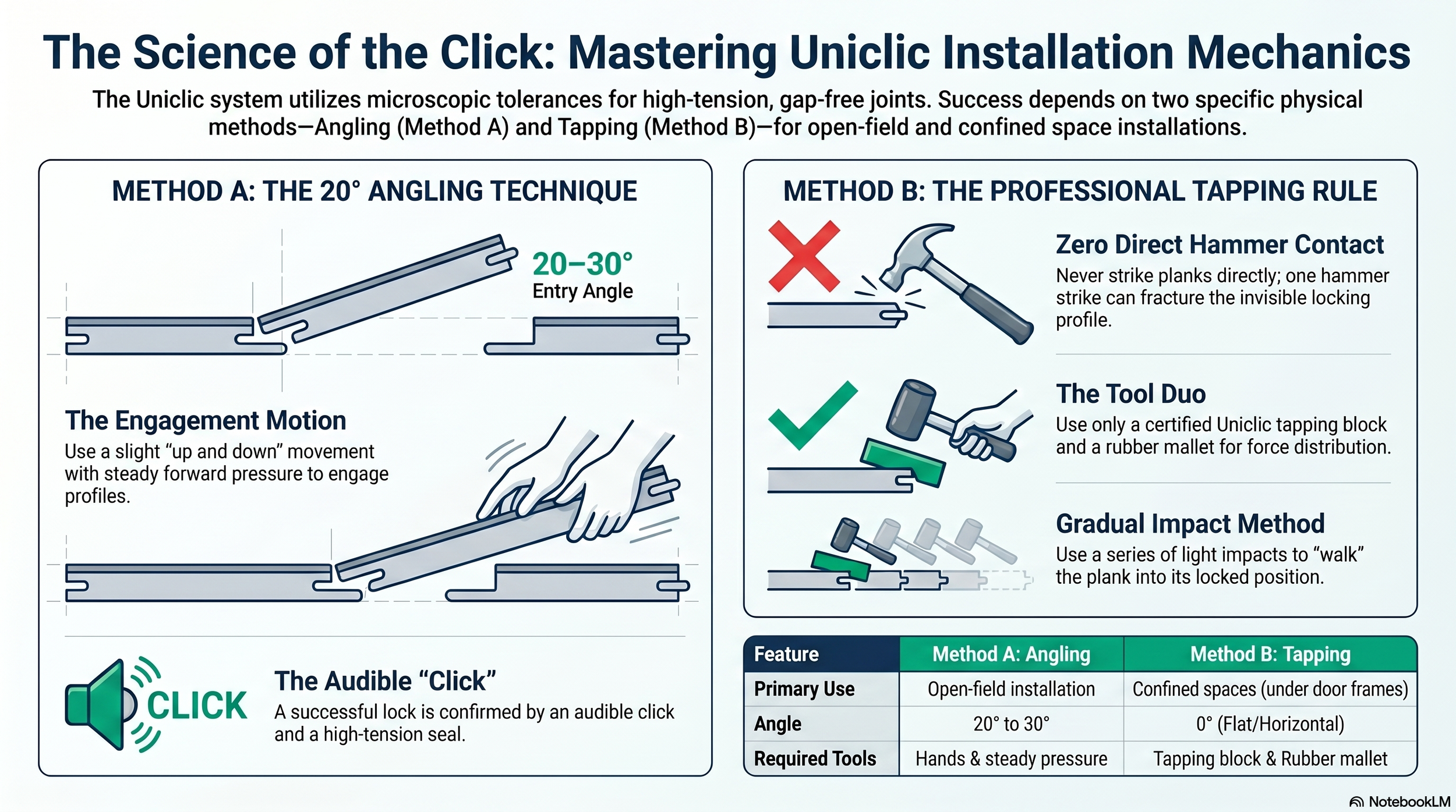
⤵️ Listen to the podcast on the hidden physics of floating floorsThe Uniclic locking system connects laminate planks through two distinct methods: Method A (angling the plank at 20–30 degrees to engage the long-side profile) for open-field installation, and Method B (flat tapping with a certified tapping block and rubber mallet) for confined spaces. Both methods rely on HDF-core locking tolerances below 0.1mm. In Tampa Bay's high-humidity environment, where planks reach the upper edge of their dimensional range after acclimatization, using a steel hammer instead of a certified tapping block is the most common cause of fractured joints during installation — a failure invisible at install time but audible within weeks.
What Is Method A and Why Does the 20-Degree Angle Matter?
Method A connects laminate planks along their long sides by holding the new plank at a 20–30 degree angle to the installed row and lowering it with steady forward pressure until the profiles click. The 20–30 degree range is not approximate — it is the geometric requirement for the tongue to enter the groove channel at a depth that allows the locking lip to engage without shearing. In Westchase and New Tampa open-plan installations, where Method A is the primary connection for 80–90% of all planks placed, a plank angled below 20 degrees forces the tongue against the groove wall instead of into the channel, crushing the locking lip on contact and preventing a flush seal.
When Is Method B Used and What Tools Does It Require?
Method B applies when physical obstructions — door casings, cabinetry, radiators — prevent the angling motion of Method A. The plank is held flat against the subfloor and driven horizontally into the previous row using a certified Uniclic-compatible tapping block and a rubber mallet. The tapping block must match the specific locking profile of the floor being installed: a standard tongue-and-groove block shears the more complex geometry of a Uniclic or Valinge joint. As of 2026, Own Style Flooring uses manufacturer-specified tapping blocks on every Lutz and Land O' Lakes project, replacing them when the contact face shows wear to maintain force distribution accuracy.
Why Is a Rubber Mallet Mandatory — Not a Steel Hammer?
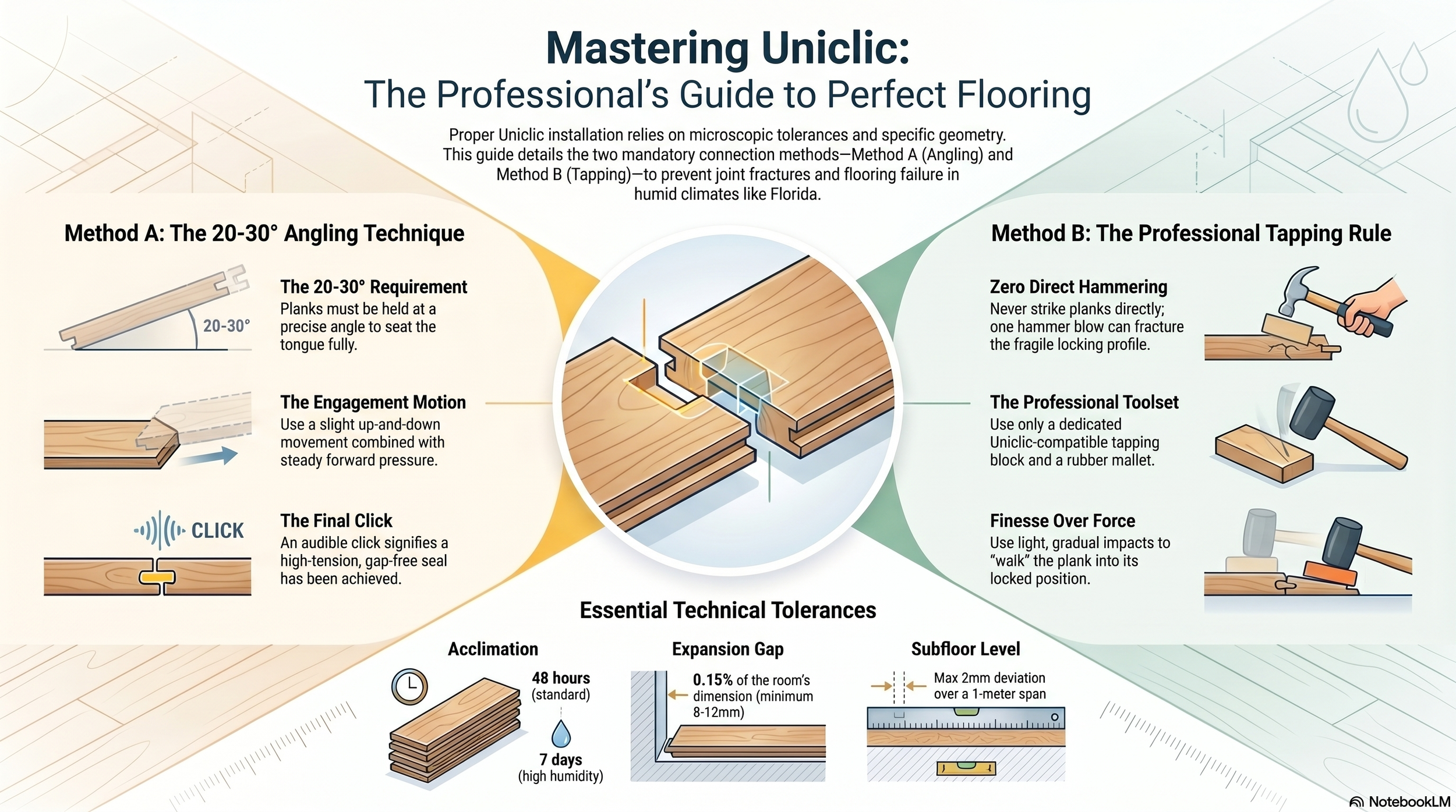
A steel hammer delivers a point-load impact with a velocity that exceeds the HDF core's fracture threshold in a single blow. The tapping block distributes force across the full width of the plank profile, but only when the mallet head's elasticity absorbs rebound energy between strikes. A rubber mallet head with Shore A hardness of 60–80 provides the correct combination of driving force and rebound dampening. A steel hammer on a tapping block bypasses the dampening effect entirely: the rigid head transmits 100% of impact energy without absorption, creating internal delamination of the HDF fiber layers at the locking tongue — damage that is invisible from the surface but renders the joint mechanically inert under dynamic load.
What Is the Correct Tapping Sequence for Method B Installation?
The correct Method B sequence uses 2–3 light, rhythmic taps rather than a single high-velocity blow. Each tap partially advances the plank toward its locked position, allowing the HDF fibers to seat without reaching their fracture point. In Lutz and Zephyrhills homes where door casings require Method B for every last-row plank, Own Style Flooring uses this gradual seating approach: first tap advances the joint 30–40%, second tap advances to 70–80%, third tap completes the lock and produces the audible click that confirms full engagement. Attempting to complete the joint in one blow — regardless of mallet type — exceeds the elastic limit of the locking lip at the moment of maximum resistance.
How Should Expansion Gaps Be Calculated in Tampa Bay Homes?
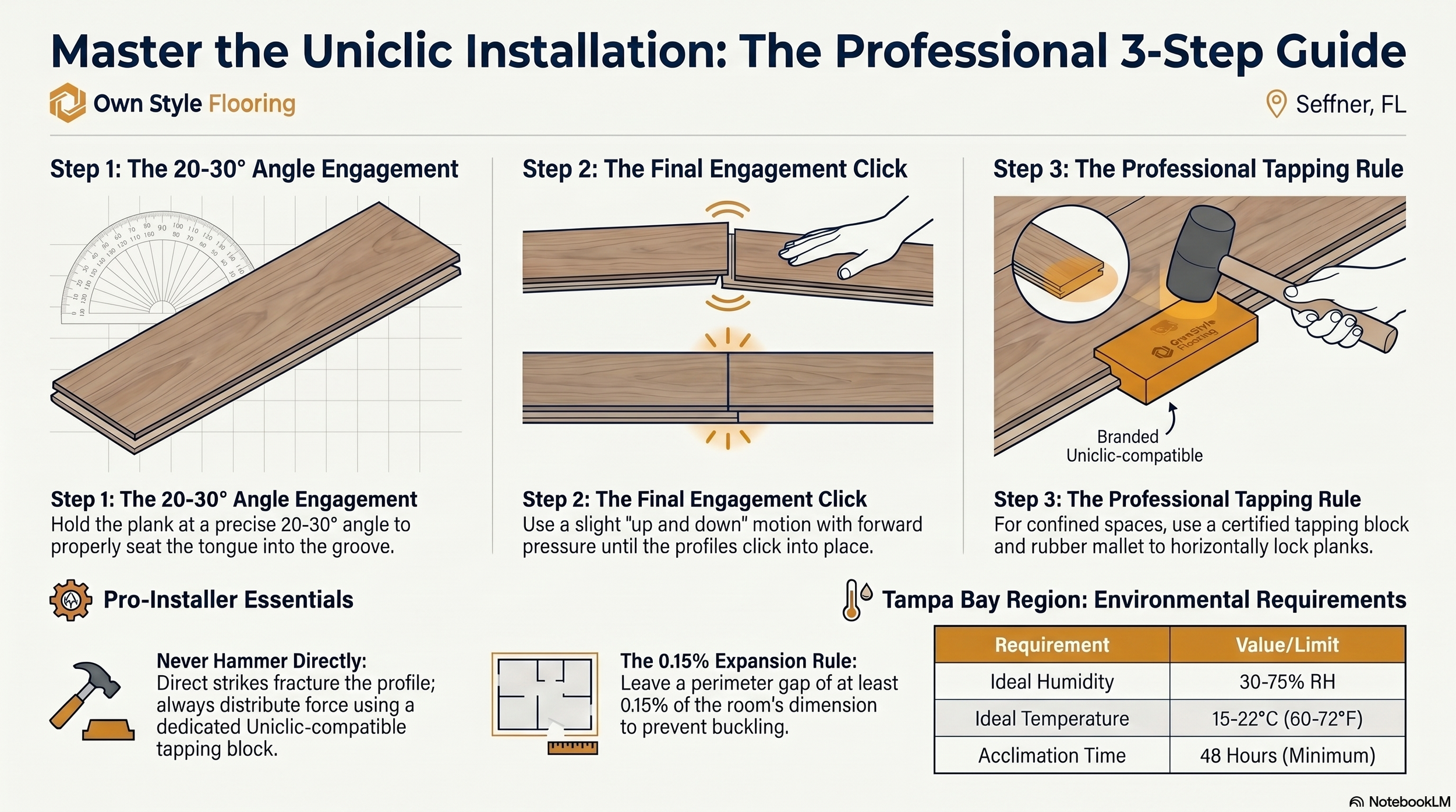
The minimum expansion gap for laminate flooring in Hillsborough County is 12mm at all perimeter walls, fixed structures, and pipe penetrations. For open-plan homes in Wesley Chapel and Land O' Lakes where rooms exceed 8 meters (approximately 26 feet) in any direction, the professional formula is 0.15% of the total room dimension in the direction of installation. A 10-meter room requires a 15mm perimeter gap; a 13-meter room requires an 18–20mm gap hidden behind baseboards. The 0.15% formula accounts for Tampa Bay's seasonal humidity swing — from 80%+ relative humidity during June through September down to 40–50% during dry winters — which produces 0.3–0.5mm of linear expansion per plank across the full humidity range.
When Is a T-Profile Expansion Joint Required Inside the Room?
A T-profile transition joint is mandatory when any continuous laminate surface exceeds 12 meters in any direction, or when flooring passes through a doorway connecting two independently expanding rooms. In Tampa Bay open-plan homes — where kitchen, dining, and living areas share an unbroken surface — the cumulative linear expansion of all planks in a 12-meter run can exceed 18mm. Without an intermediate T-profile, this expansion pressure concentrates at the perimeter gap, pushing baseboards away from the wall or buckling the floor at its weakest structural point. The T-profile absorbs the expansion of each room independently, allowing both sections to float without transferring force to each other or to fixed wall structures.
What Subfloor Conditions Does the Uniclic System Require?
The Uniclic system requires a subfloor with no more than 2mm deviation over a 1-meter span, verified with a straightedge before underlayment is placed. In Seffner and Valrico homes on slab-on-grade foundations, concrete moisture must be below 2.5% CM (carbide method) before installation begins. A subfloor deviation of 3mm over 1 meter creates a lever arm across the plank width: the click joint at the high point bears the full plank load while the joint at the low point receives none, concentrating stress at a single profile location and accelerating fatigue fracture. Own Style Flooring verifies both planimetry and moisture on every project before scheduling material delivery.
FAQ
-
Professionals hold new planks at 20–30 degrees to the installed row during Method A installation. This angle is the geometric requirement for the tongue to enter the groove channel and engage the locking lip without shearing. Angles below 20 degrees force the tongue against the groove wall and crush the locking profile on contact, preventing a flush seal and creating a visible gap that widens under humidity cycles in Hillsborough County homes.
-
Yes. The Uniclic dry-click system carries foot traffic the moment the last plank is locked and expansion spacers are removed. No adhesive curing time is required. The only restriction is avoiding standing water or wet mopping for 24 hours to allow any dust from cutting operations to be dry-vacuumed before liquid contact, which is standard practice on Own Style Flooring installations throughout Hillsborough County and Pasco County.
-
Creaking in newly installed laminate in Tampa Bay indicates one of three conditions: a tapping block was not used during Method B installation (fractured tongue creates micro-movement), the underlayment compressive strength is below 60 kPa (vertical deflection on each step), or the expansion gap is insufficient for the room's humidity range (perimeter contact forces joint movement). Own Style Flooring diagnoses each condition differently — fractured tongues require row replacement; underlayment issues require demolition; expansion gap issues require baseboard adjustment.
-
An undersized expansion gap in a Tampa Bay home fails during the first humid season. As June through September humidity drives laminate expansion to its maximum, the floor contacts the wall structure at the perimeter. With no remaining gap to absorb further expansion, the floor buckles upward at its structural weakest point — typically the center of the longest run. Buckling requires full floor removal and reinstallation with corrected gap dimensions. The 0.15% formula prevents this failure on every correctly engineered installation.
Other interesting topics
Other interesting topics