The Physics of the SD > 75m Vapor Barrier: Protecting Tampa Bay Floors from Capillary Moisture
⤵️ Listen to the podcast on vapor barriers and capillary moistureA vapor barrier with an SD value above 75 meters is the mandatory layer between a concrete slab and a laminate floor in Tampa Bay. The film blocks ground moisture equivalent to 75 meters of still air, stopping the swelling and joint peaking that ruin slab-on-grade installations within two years.
What is capillary moisture, and why does it threaten Florida floors?
Capillary moisture is groundwater that a porous concrete slab pulls upward like a wick and then releases as vapor into the floor above. In Tampa Bay, where the water table sits 3 to 8 feet below grade, an uncovered slab in Brandon or Seffner transmits enough vapor to warp a floating laminate floor within months.
Concrete never fully stops absorbing water, even after curing for years. During the June to September rainy season, soil saturation around Hillsborough County homes pushes vapor emission rates above 8 lbs per 1,000 sqft over 24 hours. A vapor barrier breaks the link between the damp slab and the moisture-sensitive HDF core of the planks.
Homeowners often blame the laminate brand when a floor cups, but the real cause sits underneath. A slab that reads above 2.5% CM moisture content will damage an unprotected floating floor regardless of plank quality, which is why every Own Style Flooring slab job starts with a moisture reading.
What does an SD value greater than 75 meters actually mean?
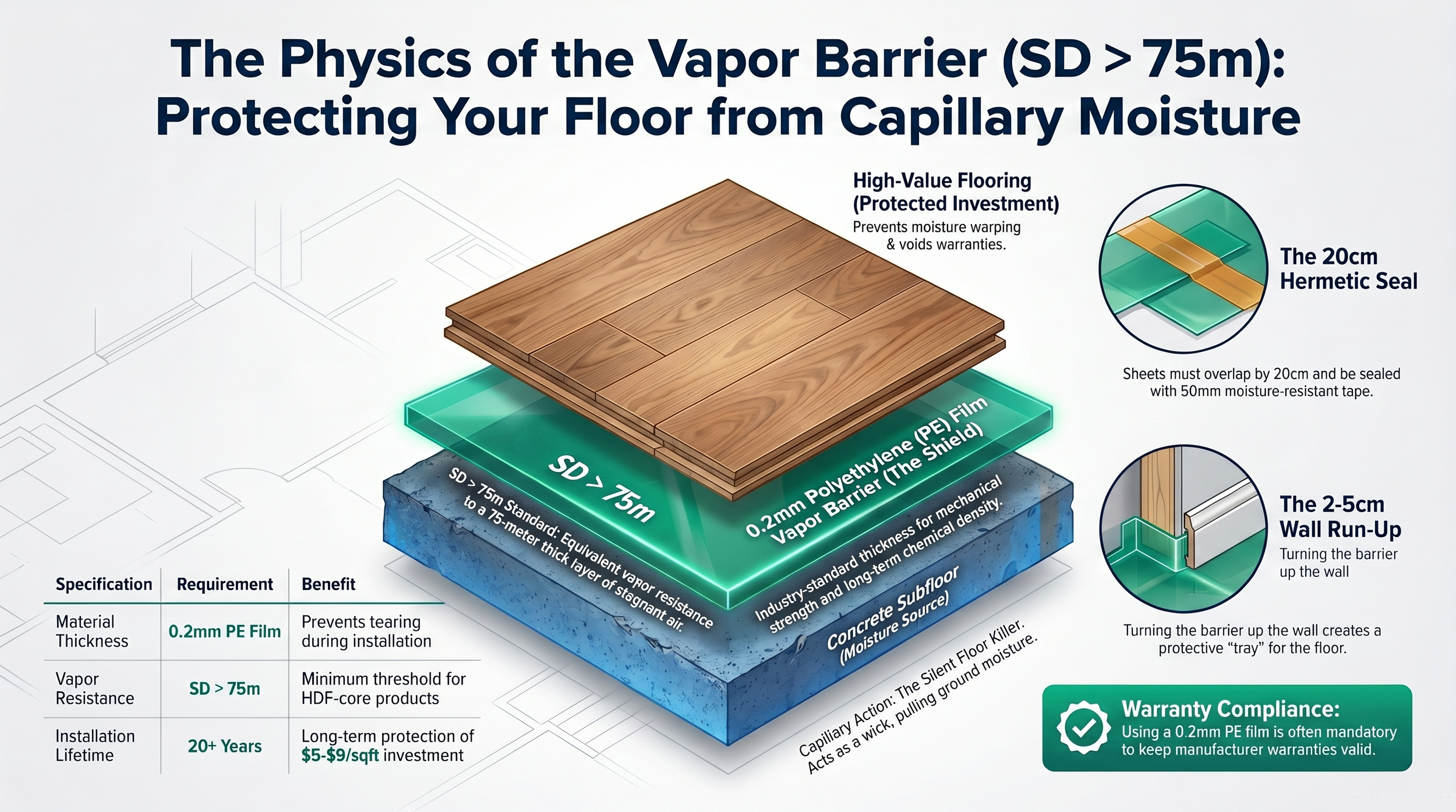
An SD value measures how strongly a material resists water-vapor diffusion, expressed as an equivalent thickness of still air. An SD value of 75 meters means a 0.2mm polyethylene film resists vapor as effectively as a 75-meter column of motionless air sitting on the slab.
For HDF-core laminate over mineral subfloors, 75 meters is the minimum engineering threshold. In St. Petersburg and Clearwater, where coastal humidity stays high through 2026, a film rated below SD 75m lets enough vapor through to trigger cupping within the first year.
The rating appears on the product technical sheet, not on the retail packaging. Comparing SD values is the only reliable way to separate a true vapor barrier from a thin sheet of plastic that offers almost no protection on a Florida slab. A reputable flooring supplier in the Tampa Bay area will list the SD figure on the spec sheet or provide it on request.
| Barrier option | SD value | Tampa Bay slab suitability |
|---|---|---|
| Painter's plastic (~0.05mm) | under 10 m | Fails — not a vapor barrier |
| Standard PE film (0.1mm) | 40–60 m | Insufficient for slab-on-grade |
| Certified PE film (0.2mm) | over 75 m | Required minimum |
Why is 0.2mm the required thickness for a PE vapor barrier?
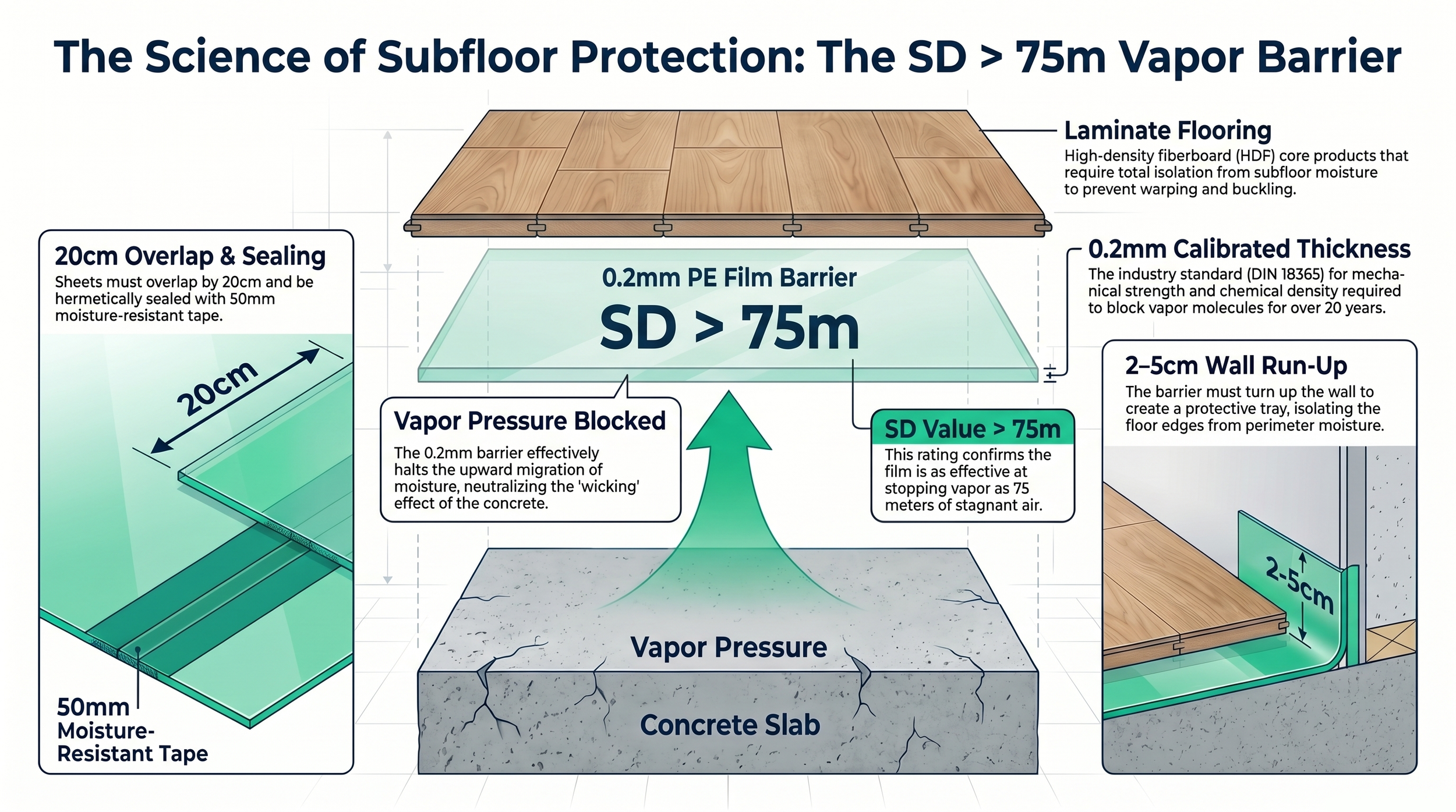
A 0.2mm polyethylene film is the thickness calibrated to survive installation without tearing while holding its vapor resistance for a 20-year service life. Thinner drop cloths and painter's plastic stretch and puncture under foot traffic, opening micro-gaps that defeat the barrier.
Industry standards such as UNE 56810 and DIN 18365 specify a 0.2mm PE film for laminate over concrete. At Own Style Flooring, the crew never substitutes a thinner sheet, because a single tear creates a localized moisture pocket that can ruin an entire room in Lutz or Valrico.
Thickness also governs how the film handles slab texture. A 0.2mm sheet bridges minor surface irregularities and resists abrasion from a rough Tampa Bay slab, while a 0.1mm sheet conforms too tightly and tears at every high spot.
How are vapor barrier seams overlapped and sealed?
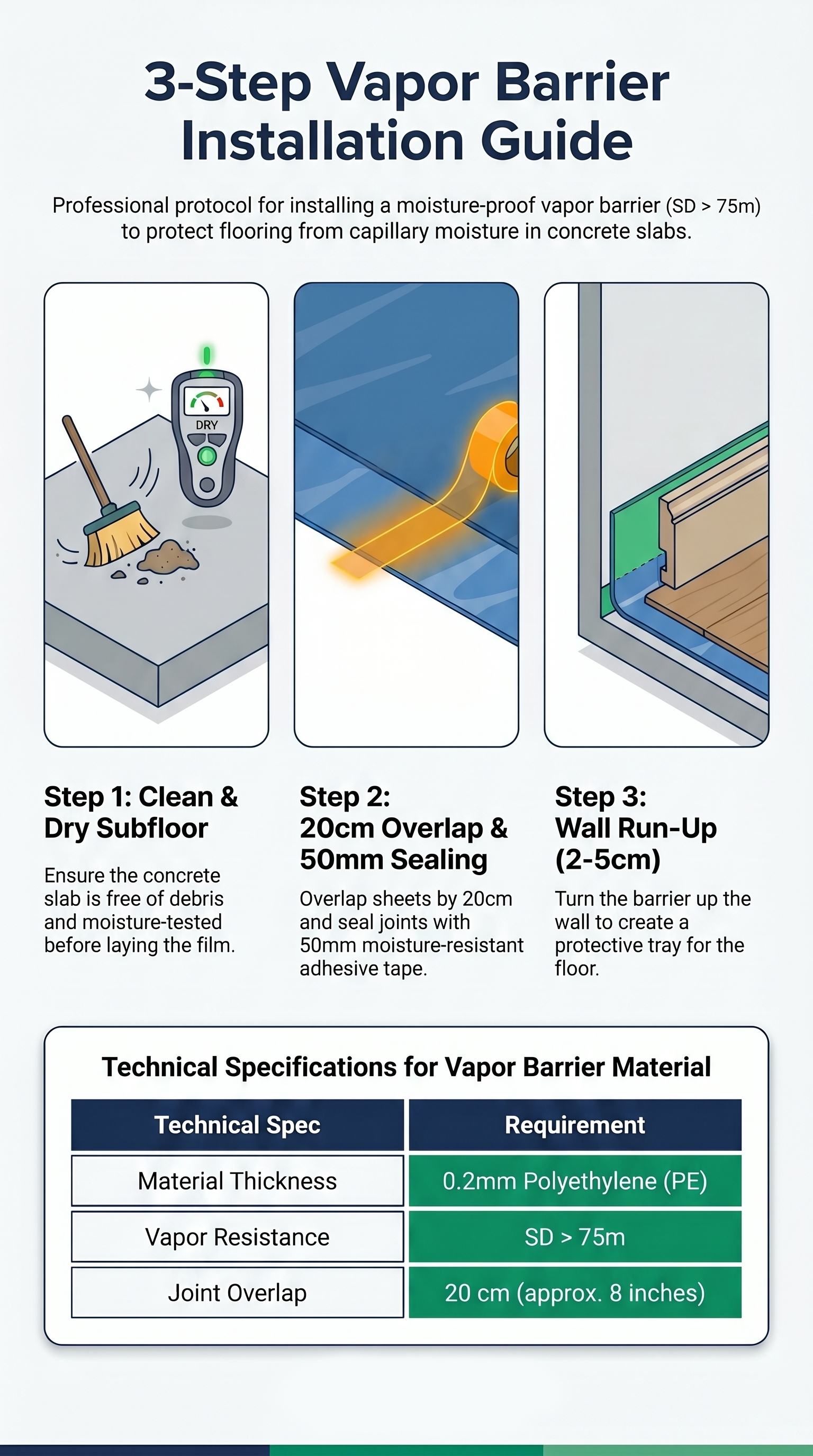
A vapor barrier performs only as well as its weakest seam, so adjoining sheets are overlapped by at least 20 centimeters (about 8 inches) and taped along the full length with 50mm moisture-resistant adhesive tape. The continuous seal stops vapor from leaking through the gaps between sheets.
Loose or untaped overlaps are the most common defect in low-cost and DIY jobs across Riverview, and the buckled joints usually surface three to six months after completion. Own Style Flooring follows a fixed sealing protocol on every Tampa Bay slab installation.
The Own Style Flooring slab protocol covers three non-negotiable steps:
- Overlap adjoining PE sheets by 20 cm minimum before taping.
- Seal every seam end to end with 50mm moisture-resistant tape.
- Leave a 10mm expansion gap at all walls and transitions.
FAQ
Why must the vapor barrier run up the wall at the perimeter?
Moisture follows the path of least resistance, so a vapor barrier that stops at the floor edge lets vapor migrate to the walls and attack the exposed edges of the laminate planks. The professional fix is to turn the barrier 2 to 5 centimeters up every wall, forming a sealed tray around the floor.
The excess film is trimmed only after the baseboards are installed, which keeps the perimeter, the most vulnerable zone, fully isolated from the damp slab. Skipping the wall run-up leaves a moisture entry point that no surface cleaning can correct.
Perimeter failures are deceptive because the center of the floor can look perfect while the planks along the walls swell and lift. A continuous tray detail prevents that pattern in older Seffner and Valrico homes built directly on grade.
Are 2-in-1 underlayments enough on Tampa Bay slabs?
Many underlayments ship with a foil or plastic backing marketed as a 2-in-1 vapor-and-cushion solution, but most fall short on Florida slabs unless the product specifically certifies an SD value above 75m. A marketing label is not a substitute for the rated specification.
For first-floor units and homes near the Hillsborough River, Own Style Flooring installs a dedicated 0.2mm PE film beneath the technical underlayment. The double-layer approach protects a $5–$9 per sqft laminate investment against the region's worst vapor loads.
Combining the two layers also separates the job each one does. A dedicated PE film handles vapor diffusion while the foam underlayment manages sound and minor leveling, so neither function is compromised on a high-moisture Tampa Bay slab.
What does skipping the vapor barrier cost a Florida homeowner?
Skipping the vapor barrier to save a few cents per square foot voids the manufacturer's warranty, because a forensic inspector checks first for the presence of a 0.2mm PE film. Without that film, cupping and crowning damage become the owner's liability, often a full $5–$9 per sqft replacement.
As of 2026, Tampa Bay labor and material costs make a second installation roughly double the original outlay. Hiring Own Style Flooring means the vapor physics of the slab are engineered correctly the first time, across Brandon, Seffner, Riverview, and the wider Hillsborough County area.
The barrier itself adds only a small fraction to the project total, while a failed floor costs the full material and labor again plus the disruption of a second demolition. Spending on the correct vapor barrier up front is the lowest-risk decision for any Florida slab.
-
A firmly bonded, non-porous, dry tile can act as its own vapor barrier, so a separate PE film is often unnecessary over tile. Own Style Flooring still verifies that the tile is level, fully adhered, and that subfloor moisture reads below 2.5% CM before installing in any Tampa Bay home.
-
An SD value above 75m means the film resists water vapor as effectively as a 75-meter column of still air. For laminate over a Florida concrete slab, SD 75m is the minimum rating that reliably blocks ground moisture from reaching the moisture-sensitive HDF core.
-
Yes. On concrete slabs in high-humidity areas like Clearwater or St. Petersburg, adding a dedicated 0.2mm PE film beneath a 2-in-1 underlayment gives maximum protection. Own Style Flooring recommends the double layer for first-floor units and homes near the Hillsborough River.
-
No. A plastic vapor barrier over a plywood or wood subfloor traps moisture and can rot the structure. Wood subfloors in Tampa Bay need a breathable membrane instead, which lets the assembly dry while still protecting the laminate above.
Other interesting topics
Other interesting topics